
Looking at Juneteenth
A timely reflection on freedom, delayed justice, and the history America must choose to remember

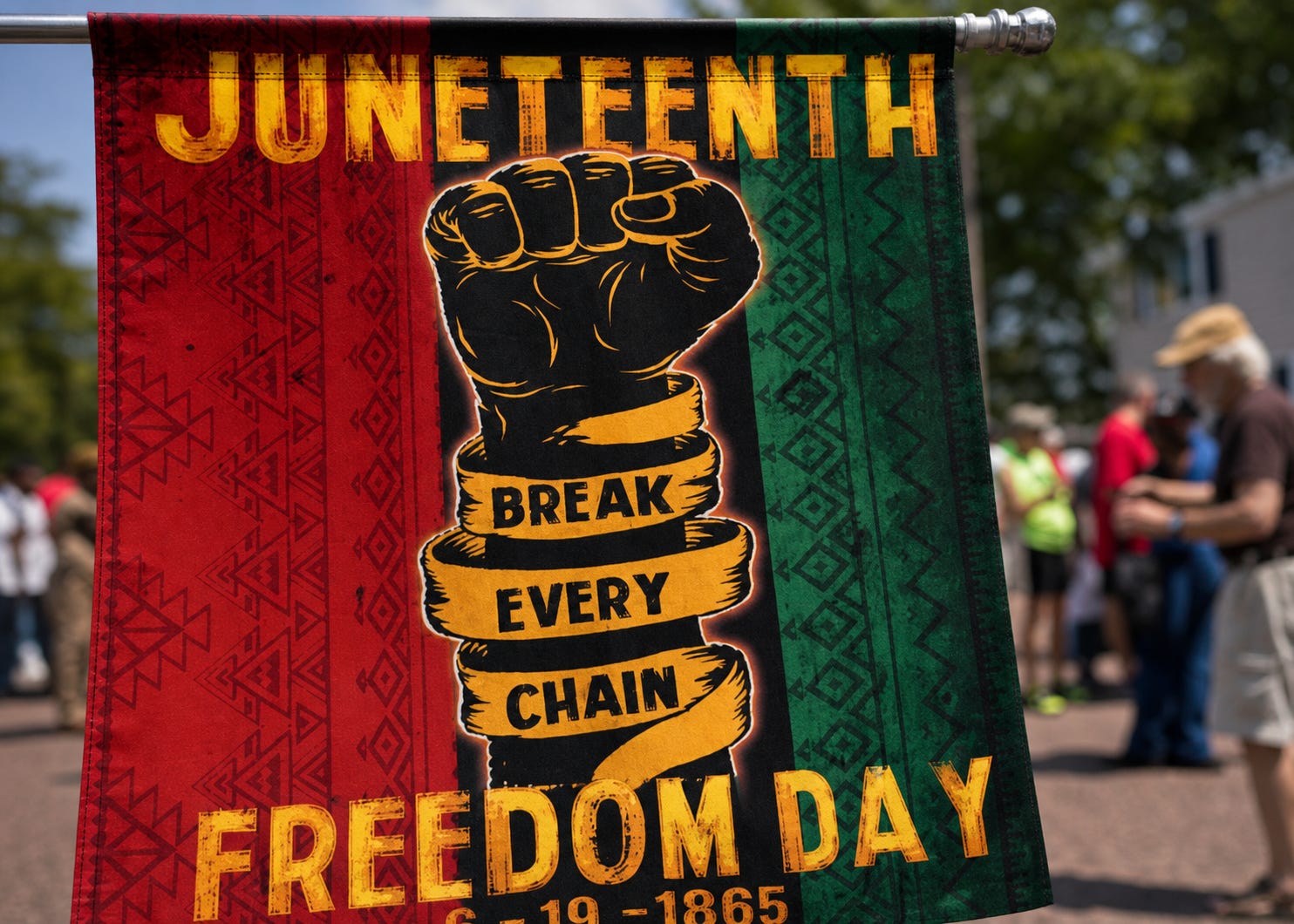
“Juneteenth is not asking America to live in guilt. It is asking America to live in truth.”
Juneteenth is one of those American holidays many people recognize before they fully understand it. They know it has something to do with slavery, freedom, Texas, and June 19. They may know it became a federal holiday in 2021. But the deeper story is richer, harder, and more important than a simple calendar note.
So, how much do you know?
Did you know Juneteenth does not mark the day Abraham Lincoln signed the Emancipation Proclamation? Did you know it does not mark the day slavery legally ended everywhere in the United States? Did you know Black Americans celebrated Juneteenth for generations before the federal government officially recognized it?
That is why Juneteenth matters. It is not only a celebration of freedom. It is also a lesson in delayed justice, public memory, and the long struggle to make American ideals real.
The Day Freedom Reached Texas
Juneteenth traces back to June 19, 1865, when U.S. Maj. Gen. Gordon Granger arrived in Galveston, Texas, with Union troops and issued General Order No. 3. The order informed the people of Texas that enslaved people were free. This was more than two years after Lincoln’s Emancipation Proclamation had taken effect on January 1, 1863.
That delay is the heart of the story. Freedom had been declared, but it had not been enforced in much of Texas. The Civil War was ending, Confederate resistance had collapsed, and federal authority had finally reached one of the most remote slaveholding regions of the former Confederacy.
For the enslaved people of Texas, this was not an abstract legal development. It was a life-altering announcement. Families, bodies, labor, movement, marriages, names, and futures had been controlled by others. General Order No. 3 did not magically repair the damage slavery had done, but it marked a public break with the legal system that had treated human beings as property.
The Emancipation Proclamation Was Not the Finish Line
One of the most common misunderstandings about Juneteenth is the idea that Lincoln freed all enslaved people everywhere with one signature. The truth is more complicated.
The Emancipation Proclamation was a wartime measure. It declared enslaved people free in areas rebelling against the United States, but it did not immediately free enslaved people in Union border states. It also depended on the advance of Union power. In places where the federal government could not enforce it, enslavers continued to hold people in bondage.
That is why Juneteenth is so powerful. It reminds us that rights are not real simply because they are announced. They must be enforced, defended, and lived.
Slavery was not abolished throughout the United States until the Thirteenth Amendment was ratified in December 1865. That distinction matters. Juneteenth marks a decisive moment in emancipation, especially for Texas, but it sits within a broader process of liberation that unfolded unevenly across the country.
Why Texas?
Texas was geographically distant from many of the major Civil War battlefields. As Union forces advanced elsewhere, some enslavers moved enslaved people into Texas, hoping to preserve slavery as long as possible. By 1865, hundreds of thousands of Black people remained enslaved there.
This is why Galveston became so central to the story. When Granger arrived, the message of emancipation came backed by federal troops. The promise of freedom finally had force behind it.
Still, freedom did not mean safety. Formerly enslaved people faced violence, economic exploitation, political suppression, and the enormous challenge of building lives in a society that had profited from their bondage. The end of slavery was not the end of racism. It was the beginning of a new struggle over citizenship, land, wages, education, voting rights, and human dignity.
A Holiday Built by Black Communities
Juneteenth was not born in Congress. It was born in Black memory.
Formerly enslaved people and their descendants began gathering to remember June 19. They prayed, sang, cooked, preached, organized, and celebrated. Early Juneteenth observances often included church services, speeches, family gatherings, parades, and community meals. Red foods and drinks became part of many celebrations, symbolizing resilience, sacrifice, and cultural continuity.
These gatherings were acts of joy, but also acts of resistance. In a country eager to move on from slavery without fully confronting it, Black communities insisted on remembering. They taught their children what had happened. They honored ancestors who endured the unimaginable. They celebrated freedom in public, even when that freedom was threatened.
That is one of the great lessons of Juneteenth: oppressed people often preserve the truth before institutions are willing to recognize it.
From Texas Holiday to Federal Holiday
Texas made Juneteenth an official state holiday in 1980. That recognition came after years of advocacy, especially from Black Texans who understood the day’s historical and cultural importance.
The national movement continued for decades. One of its best-known champions was Opal Lee, often called the “Grandmother of Juneteenth.” Her activism helped bring national attention to the holiday and its meaning.
In 2021, Congress passed the Juneteenth National Independence Day Act, and President Joe Biden signed it into law on June 17. Juneteenth became the first new federal holiday since Martin Luther King Jr. Day.
That was a major symbolic victory. National holidays shape what a country remembers. They become part of civic education. They tell citizens what deserves public honor.
But recognition also brings risk. Once a holiday becomes official, it can be softened, commercialized, or stripped of its deeper meaning. Juneteenth should not become merely another sale, slogan, or day off. Its purpose is remembrance, truth, celebration, and recommitment.
Juneteenth in 2026
In 2026, Juneteenth arrives in a politically charged moment. Debates over race, history, diversity programs, voting rights, and school curricula continue across the country. Some political leaders speak warmly about freedom while resisting honest discussion of slavery and its legacy. Others try to frame Black history as divisive, when in fact it is essential to understanding America.
That makes Juneteenth more important, not less.
A holiday about delayed freedom speaks directly to the present. It reminds us that progress can be real and incomplete at the same time. It reminds us that a nation can pass laws while still failing to protect people equally. It reminds us that public memory is never neutral. What we choose to remember shapes what we are willing to repair.
Recent controversies over federal observances, civil rights history, and the treatment of holidays like Juneteenth and Martin Luther King Jr. Day show that the struggle over memory is ongoing. When a society minimizes its freedom struggles, it also weakens its democratic conscience.
What Should We Know?
If Juneteenth asks, “How much do you know?” the answer should go beyond trivia.
We should know that enslaved people were not passive recipients of freedom. They resisted, escaped, organized, informed Union forces, served in the military, protected families, and claimed personhood in every way available to them.
We should know that emancipation was not a single event. It was a process involving law, war, political struggle, Black courage, and federal enforcement.
We should know that Reconstruction brought real democratic possibility, including Black political participation, public education, and civil rights advances, before white supremacist violence and political betrayal rolled many of those gains back.
We should know that Juneteenth belongs to Black history, and because Black history is American history, it belongs in the nation’s public memory.
Most of all, we should know that freedom is not self-executing. It must be practiced.
More Than a Celebration
Juneteenth is joyful, and it should be. It is a day for music, food, family, festivals, history, prayer, and pride. But its joy has depth. It is not the joy of forgetting pain. It is the joy of surviving it.
The holiday honors people who were denied wages, names, rights, education, legal marriage, family security, and bodily autonomy, yet still built culture, faith, resistance, and hope. It honors those who heard the news in 1865 and began imagining lives that slavery had tried to make impossible.
So, how much do we know about Juneteenth?
Enough to celebrate, perhaps. But celebration is only the beginning.
To truly honor Juneteenth, America must tell the truth about slavery, teach the history of emancipation, protect voting rights, confront racial inequality, and refuse to treat freedom as a finished project.
Juneteenth is not asking America to live in guilt. It is asking America to live in truth.
And truth, when we are brave enough to face it, is one of the deepest forms of freedom.
Before you go, tap the ❤️ and re-stack this post so we can put it in front of as many readers as possible.
I know some may not want to commit to a paid subscription, but if you’d like to support my work, you can always buy me a coffee on Ko-fi. Your contribution helps sustain independent writing rooted in consciousness, compassion, and social renewal. Every bit of support truly makes a difference.
Sources
Associated Press, “How much do you know about Juneteenth? Test your knowledge”
Associated Press, “A guide to what the Juneteenth holiday is and how to celebrate it”
National Archives, “Juneteenth General Order No. 3”
Smithsonian National Museum of African American History and Culture, “Juneteenth”
Library of Congress, “Today in History: June 19”
Britannica, “Juneteenth”
Pew Research Center, “Which states recognize Juneteenth as an official holiday?”
Beautiful reminder that the truth is in the details.
“Juneteenth is not asking America to live in guilt.
It is asking America to live in truth.”
Truer words never spoken. But Trumpism sees it (guilt) backwards … perhaps because they realize the truth, but it doesn’t set THEM free from their bigotry?
Someone told me that Trump now intends to sign the MOU with Iran - not on Friday - but today,
— for fear there wd be association with Juneteenth & Iranian freedom. 🙄