
Democracy, Redacted
How Judge Aileen Cannon Buried Jack Smith’s Report on the Classified Documents Case

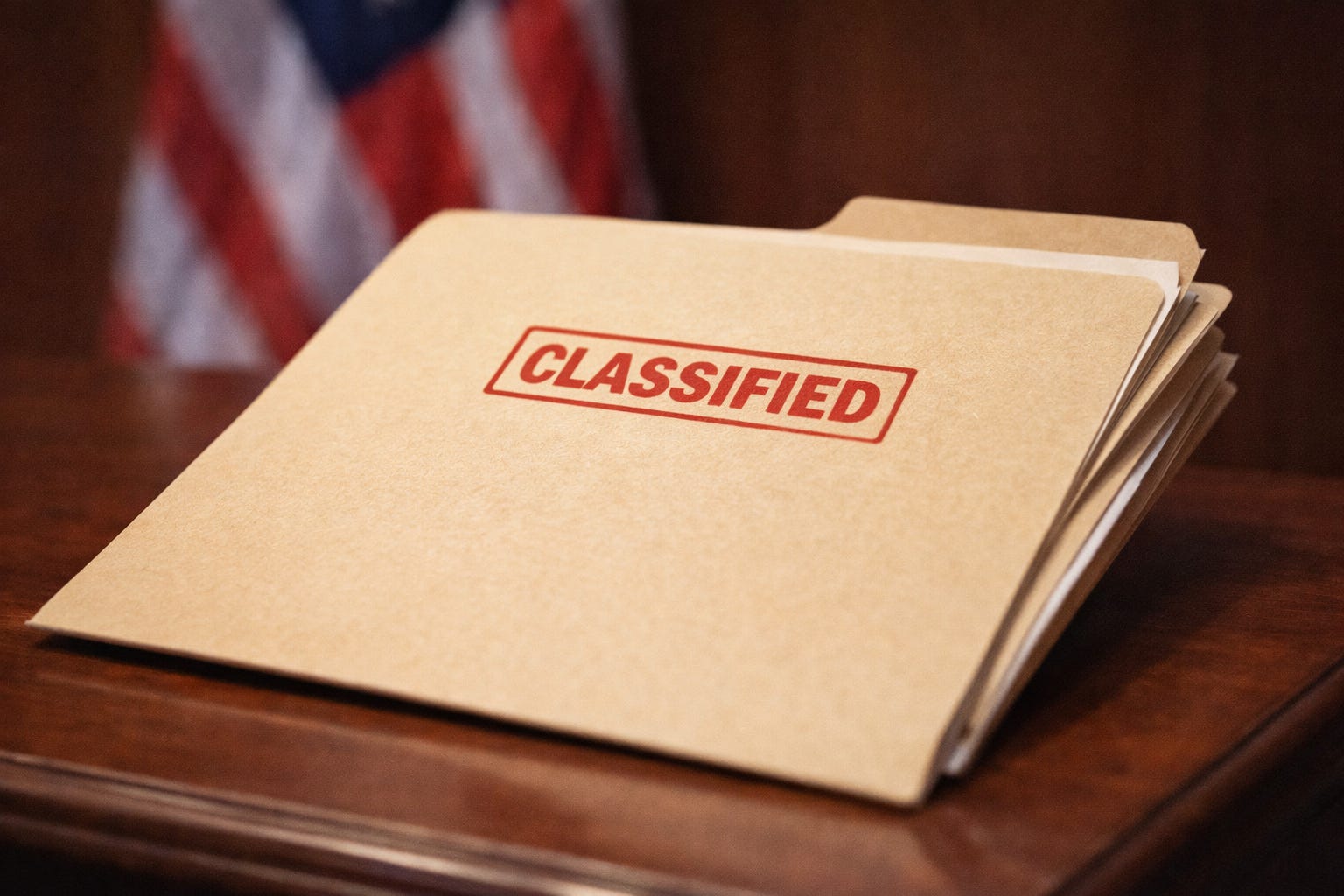
“A report about classified documents has itself been classified from the public.”
There is something almost majestic about a finished investigative report that the public will never see. It exists. It has pages. It likely has footnotes, exhibits, and the sort of sober prose designed to withstand appellate review. And now, thanks to a federal ruling reported by AP News, it has achieved its highest calling in modern American politics: permanent invisibility.
A federal judge has permanently barred the release of Volume II of special counsel Jack Smith’s report examining the classified documents case involving Donald Trump. The order binds not only the current attorney general, Pam Bondi, but her successors as well. In other words, this is not a pause. It is a burial.
The election interference volume of Smith’s report was released earlier. The classified documents volume is the one now locked away. Democracy, apparently, is on a need-to-know basis, and we do not need to know.
You almost have to admire the elegance. Why endure the mess of public transparency when you can simply declare the story complete and lock the manuscript in a drawer?
The Case That Ended Twice
To understand how we got here, you have to appreciate the procedural choreography.
After Trump won the 2024 election, Smith moved to abandon both federal indictments, including the classified documents case, citing longstanding Justice Department policy that sitting presidents cannot be prosecuted. That alone would have paused the courtroom drama.
But Judge Aileen Cannon had already dismissed the Mar-a-Lago case on separate grounds, ruling that Smith had been unlawfully appointed as special counsel. In her view, the entire prosecution rested on defective authority.
So the case ended not with a verdict, but with a double exit. DOJ policy closed one door. Cannon’s ruling closed another. And now her latest order ensures the investigative narrative behind it all remains sealed.
It is an impressive feat. The legal system has managed to produce a full investigation, a detailed report, and a complete blackout.
If You Never Release the Grades, Everyone Passes
Cannon’s reasoning rests on familiar constitutional language. The defendants were never convicted. They retain the presumption of innocence. Releasing the report, she argues, would risk “manifest injustice.”
On paper, that sounds restrained and principled. In practice, it feels like refusing to return the final exam because the grading process became controversial. If no one sees the red ink, technically, no one was embarrassed.
There is something delicate about the assumption that the American public cannot handle factual findings without a jury verdict attached. We are trusted to elect presidents, evaluate candidates, and argue endlessly about policy. But reading a special counsel’s account of evidence? That, apparently, is too destabilizing.
Better to shield us from context.
The implication is subtle but powerful. Unless guilt is formally declared in court, the public has no legitimate claim to the assembled facts. Investigation becomes an internal memo rather than a civic reckoning.
The Ultimate Spoiler Alert
From a political communications standpoint, this is almost genius. Had Volume II been released, it would have dominated headlines for a week, been reduced to bullet points, debated on cable news, and then gradually absorbed into the background noise of American life.
Instead, it becomes a legend. The Lost Volume. The Forbidden Report. The Civic Scroll We Were Not Ready For.
You cannot quote what you cannot read. You cannot challenge specific passages. You can only speculate. Was it explosive? Was it procedural and dry? Did it clarify gray areas or simply restate known facts?
By sealing it, the court ensures that it will loom larger in imagination than it might have on paper.
Transparency, With Conditions
American politics has long treated transparency as a sacred word. Sunlight is the best disinfectant. The public has a right to know. Accountability requires disclosure.
Except sometimes disclosure is reframed as cruelty.
In this case, secrecy is recast as fairness. Releasing the report might harm reputations. It might violate norms. It might conflict with the presumption of innocence.
Norms are remarkably flexible tools. They expand when we demand exposure and contract when exposure becomes inconvenient. Transparency is a virtue until it threatens someone powerful. Then it becomes a potential injustice.
Meanwhile, watchdog groups such as American Oversight and the Knight First Amendment Institute have argued that continued suppression is difficult to square with the First Amendment and historical practice surrounding special counsel reports. They intend to keep fighting for release.
So this is not merely a procedural footnote. It is a live dispute about who controls the public record.
The Precedent That Whispers
The deeper question is structural. If investigative reports can be permanently sealed whenever charges are dismissed, what becomes of public accountability?
Convictions are not the only measure of democratic health. Context matters. Explanations matter. Citizens are routinely asked to assess judgment, character, and adherence to law, not merely to tally guilty verdicts.
Remove the explanatory layer, and accountability shrinks to a binary. Guilty or not guilty. Case dismissed. Nothing further.
But complex constitutional crises rarely fit into clean binaries. Reports exist precisely to illuminate the gray zones, to explain how close conduct came to crossing legal lines, and to document what institutions discovered in the process.
Seal the report, and those gray zones remain comfortably gray.
Closure Without Content
There is something theatrical about declaring the matter closed while withholding the script. The investigation ran its course. The case is dismissed. The report exists. Please move along.
Move along from what, exactly?
We are offered closure without content. Resolution without revelation. It is like attending the final act of a courtroom drama only to be told that the verdict was delivered backstage. Trust us, it was compelling.
Perhaps the report was devastating. Perhaps it was anticlimactic. The point is not the tone. The point is that it was prepared in the name of the public and is now withheld from the public.
And so the classified documents case achieves its final irony. A prosecution centered on the alleged mishandling of secret material ends with a judicial decree that the investigative record itself must remain secret.
Nothing says confidence in democratic resilience quite like assuring citizens that the full story has been written, carefully reviewed, and permanently withheld for their own good.
I know some may not want to commit to a paid subscription, but if you’d like to support my work, you can always buy me a coffee on Ko-fi. Your contribution helps sustain independent writing rooted in consciousness, compassion, and social renewal. Every bit of support truly makes a difference.
Thanks, Michael ❣️
Comfortably gray 🩶💔 😭