

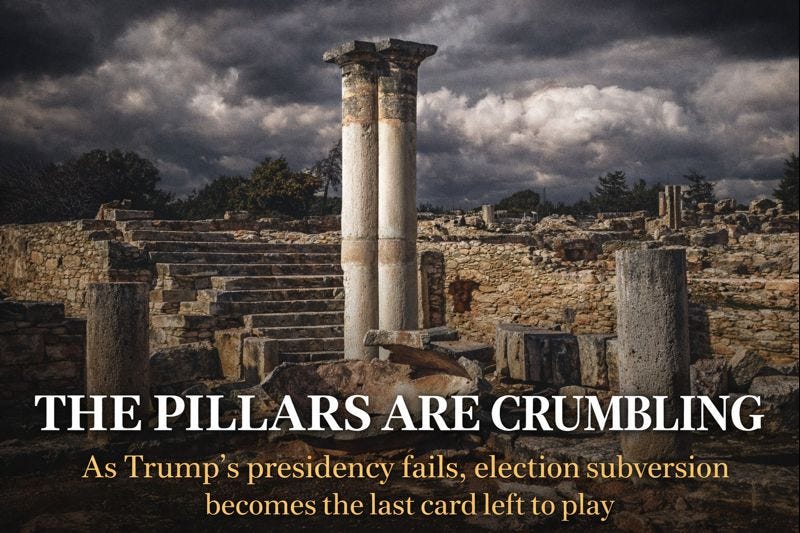
“When persuasion fails, and governance collapses, the vote itself becomes the obstacle. That is the danger now coming into focus.”
Donald Trump sold the presidency as a performance of power. He promised dominance instead of deliberation, disruption instead of governance, and grievance instead of policy. For a time, that model worked politically. It generated attention, loyalty, and fear. But governing is not campaigning, and spectacle cannot substitute for results forever. The pillars of Trump’s presidency are cracking in public, and as they fail, only one option remains.
Trump’s governance model depends on showmanship. Threats replace strategy. Declarations replace planning. Television moments replace measurable outcomes. This approach thrives on immediacy, not endurance. It creates the illusion of motion without progress. Over time, voters notice that nothing actually gets built, fixed, or stabilized. Deals collapse. Deadlines pass. Promises quietly vanish. The performance continues, but the substance never arrives.
Grievance politics was the fuel that powered this engine. Trump positioned himself as the avatar of resentment, a champion for those who felt ignored, disrespected, or displaced. That anger was directed outward toward immigrants, journalists, judges, educators, protesters, and entire cities. It worked because it felt emotionally satisfying. But grievance has a shelf life. Anger does not lower grocery prices or stabilize housing. When daily life remains difficult, resentment starts to feel like misdirection.
The culture war, once a reliable mobilizer, now shows signs of exhaustion. The same enemies are recycled. The same moral panics are repackaged. What once felt transgressive now feels stale. Politics becomes an endless loop of outrage without resolution, and even loyal supporters begin to feel the fatigue.
Institutional disruption was sold as strength but produced fragility. Courts, elections, civil servants, inspectors general, and independent agencies were treated as enemies. Oversight was framed as sabotage. Loyalty replaced competence. Institutions exist to make power durable. When they are weakened, the presidency becomes erratic and ineffective. A government at war with its own systems cannot govern a complex society.
Foreign policy exposed this hollow strength most clearly. Trump promised to dominate allies and intimidate adversaries. Instead, alliances frayed, credibility eroded, and authoritarian leaders learned that chaos could be exploited. Loud ultimatums were followed by quiet retreats. Treaties were abandoned without replacements. The image of dominance cracked under the pressure of reality.
Even the economic story is unraveling. Trump branded himself as a master dealmaker for working people. What materialized were tax cuts tilted toward corporations and the wealthy, paired with instability and rising insecurity for everyone else. Populist language masked conventional elite outcomes. The gap between promise and lived experience keeps widening.
This erosion leaves Trumpism with a shrinking set of options. When governance fails and persuasion weakens, power must be preserved by other means. That is where elections enter the picture.
Efforts to undermine democratic outcomes are no longer theoretical. They are already underway. Election denial has been normalized within the movement, turning losses into alleged fraud by default. State-level efforts to restrict ballot access, shorten voting windows, purge voter rolls, and criminalize routine election administration are advancing under the banner of “integrity.” Loyalists who reject the legitimacy of prior results are being positioned inside election offices and oversight roles. Legal pressure campaigns against election workers have driven experienced professionals out, creating vulnerability through attrition.
The goal is not to win broad consent. It is to control the machinery when consent cannot be obtained.
This is the final logic of a failing strongman model. When performance no longer persuades, and grievance no longer mobilizes, democracy itself becomes the obstacle. The only remaining move is to discredit, distort, or override the vote.
This matters beyond Trump. His presidency tested the idea that a democracy could be governed through permanent conflict, humiliation, and spectacle. The results are now visible. Chaos does not produce stability. Division does not produce prosperity. Institutions cannot be attacked without consequence.
Trump’s presidency is failing not because it lacks aggression or volume. It is failing because its strategy cannot produce durable outcomes. Showmanship excites but does not sustain. Grievance mobilizes but does not build. Disruption shocks but does not govern.
Pillars rarely collapse all at once. They crack, lean, and weaken until the structure they support can no longer stand. When that moment arrives, the temptation is not reform, but force. That is the danger now in view.
I know some may not want to commit to a paid subscription, but if you’d like to support my work, you can always buy me a coffee on Ko-fi. Your contribution helps sustain independent writing rooted in consciousness, compassion, and social renewal. Every bit of support truly makes a difference.
Grievance does indeed have a shelf life, not all followers can afford to continue believing in Trump’s fantasies … and some more honest hearted one don’t want to.
Substack commenters have noted seeing fewer red hats - and the few wearing them seem embarrassed!