
When Santa Stops Selling
What a Post Capitalist Society Does to Christmas

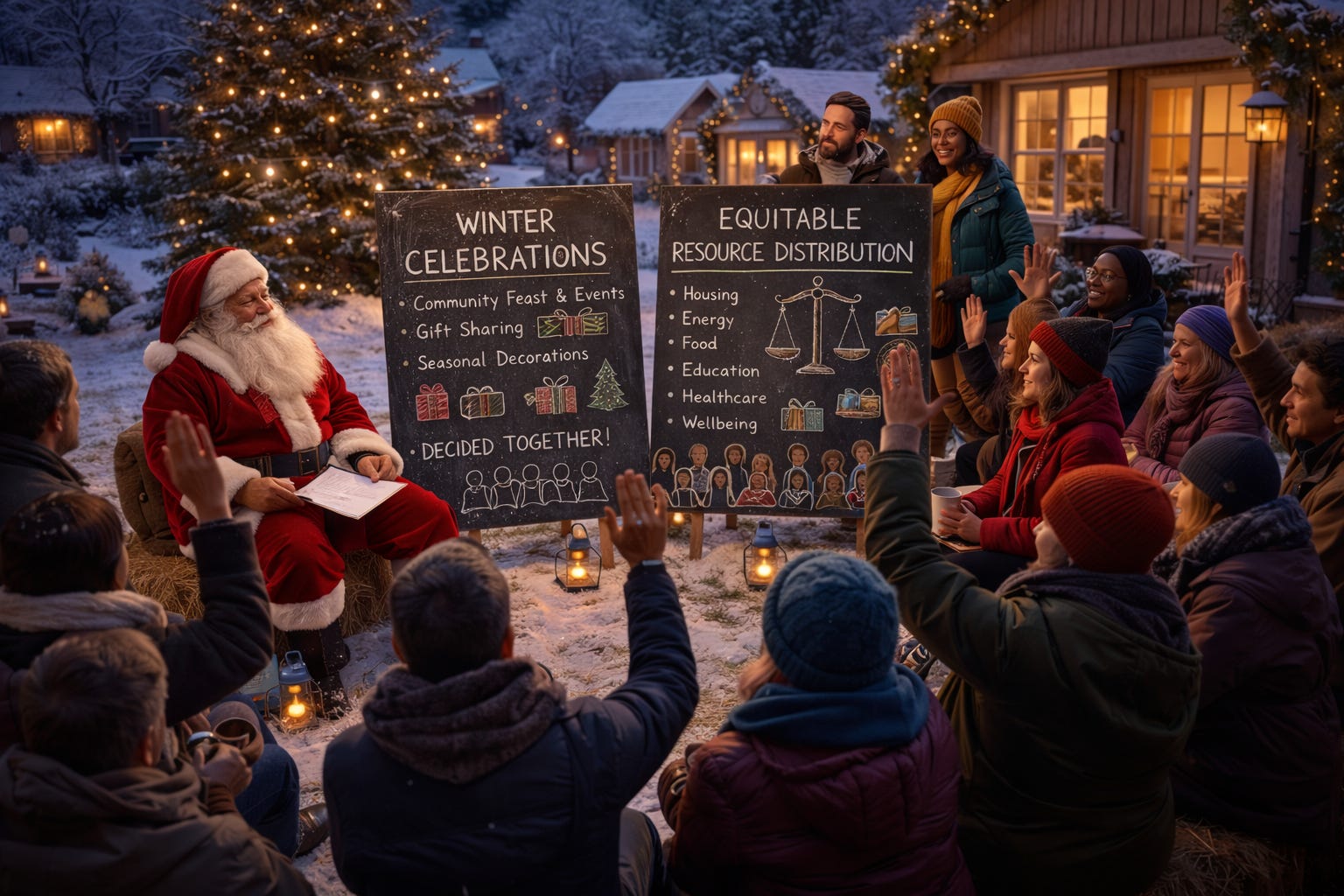
“Freed from brand deals, Santa Claus softens. He becomes less a manager of behavior and more a symbol of continuity.”
December arrives quietly.
No countdown clocks blink on screens. No inbox declares a final chance to save. No algorithm senses emotional vulnerability and responds with a coupon code. The season simply comes, the way winter always has, with shorter days, longer evenings, and a subtle invitation to slow down.
This is the first noticeable change in a society organized around Resourceism and supported by participatory democracy. Christmas feels different, not because anyone voted on it, rebranded it, or issued a memo. It feels different because the economic pressure that once clung to it like static has lifted. When an economy no longer depends on perpetual consumption to survive, its holidays stop performing emotional labor on behalf of markets.
Santa Claus, still very much present, notices the difference too.
How Capitalism Taught Santa to Shout
The modern American Santa Claus did not emerge by accident. He was shaped by war, nationalism, and later by capitalism’s need for a friendly face to sell abundance. Once the Civil War passed into memory and industrial wealth spread unevenly across the population, Santa became the ambassador of reassurance. Look, he seemed to say, there is enough. Look how full his arms are.
Over time, that reassurance hardened into obligation. Santa became customer support for an anxious economy. His image appeared everywhere from credit card commercials to luxury car ads parked improbably in suburban driveways. He smiled beside slogans promising joy delivered in two days or less. He absorbed the emotional weight of a system that taught people to equate love with purchasing power.
Santa did not corrupt Christmas. Christmas was conscripted.
In a market system driven by artificial scarcity, the holiday became a seasonal release valve. Buy now. Feel later. Prove care through acquisition. Santa’s red suit became less a symbol of warmth and more a uniform for retail urgency. Somewhere along the way, he started shouting.
What Changes When Scarcity Is No Longer a Business Model
Resourceism begins with a simple but radical premise. Human needs are not infinite. Resources, when intelligently managed, are abundant enough to meet those needs without coercion, competition, or profit extraction. Instead of organizing society around markets and money, Resourceism organizes it around shared access, transparency, and long-term stewardship.
Participatory democracy supports this model by giving people a direct voice in how resources are allocated and how communities function. Decisions are not outsourced to distant corporations or financial abstractions. They are made openly, locally, and with accountability.
One immediate consequence is that scarcity loses its theatrical role. There is no holiday supply chain crisis breathlessly reported on cable news. No pundits warn that disappointing toy sales threaten the national mood. No one frames fewer purchases as economic failure.
Without scarcity as a motivator, Christmas stops carrying the weight of the entire year’s emotional deficit. It no longer needs to compensate for insecurity, exhaustion, or neglect. It becomes, again, a season rather than a performance.
Christmas Without Performance Anxiety
In this society, gifts still exist. Children still anticipate surprises. Adults still give. What disappears is the pressure to translate love into price points.
There are no viral haul videos proving the holiday happened. No parents quietly measuring their adequacy against curated social feeds. No influencer whispering “you deserve this” while linking a sponsored mug that promises self-care but delivers clutter.
Instead, gifts take many forms. Shared projects. Handmade objects. Time set aside without apology. Experiences shaped by local culture and collective input. The absence of economic anxiety allows generosity to feel natural rather than staged.
This is not austerity. It is relief.
When basic needs are met year-round, abundance stops shouting and starts breathing. Christmas becomes spacious. There is room for silence, laughter, memory, and rest. The season no longer asks people to prove their worth through consumption.
Santa After the Sponsored Content Era
Santa remains, but he changes.
He is no longer everywhere, because he does not need to be. He is no longer urgent, because nothing is being sold through him. His image appears in stories, festivals, and community gatherings rather than plastered across every available surface.
Freed from brand deals, Santa softens. He becomes less a manager of behavior and more a symbol of continuity. The naughty and nice list quietly fades into irrelevance, not because society becomes morally lax, but because it no longer requires surveillance disguised as folklore. In a participatory culture, trust replaces monitoring.
There is gentle satire in imagining Santa finally getting a decent night’s sleep. No late-night ad shoots. No seasonal PR crises. No responsibility to prop up quarterly earnings. Just a character allowed to exist at human scale.
He still smiles. He still arrives. But he no longer carries the weight of an economy on his back.
Participatory Democracy Shapes the Holiday
The most profound transformation of Christmas comes not from Santa, but from the way people gather.
In a participatory democracy, communities decide together how to mark the season. Public spaces host shared meals, music, storytelling, and cooperative projects. Decorations are created collectively rather than purchased en masse. Celebrations reflect local rhythms rather than national marketing calendars.
There are no city council debates over which corporation gets naming rights to the Christmas tree. There are discussions instead about accessibility, inclusion, and care. How do elders participate? How do children contribute? How does the celebration reflect who we are now?
Santa appears within these gatherings as a familiar figure, not an authority. He waves. He jokes. He listens. He belongs to the scene rather than directing it. He is part of the fabric, not the justification.
What Quietly Disappears
The most telling changes are subtle.
Seasonal burnout vanishes, the kind once mislabeled as holiday spirit. Guilt spending dissolves. January remorse, marketed as self-improvement, never arrives. There is no collective crash after the decorations come down.
What replaces these patterns is not emptiness, but balance.
People rest without feeling lazy. They play without documenting it. They mark the turning of the year without needing to escape it. The holiday stops compensating for systemic stress and starts reflecting collective well-being.
This is what happens when a society no longer needs its rituals to anesthetize pain. They become expressions rather than distractions.
Santa Shrinks, Christmas Expands
Resourceism does not abolish Santa Claus or Christmas. It removes the economic distortions that overinflated them.
Santa grows smaller in the cultural imagination, and in doing so becomes truer. Christmas grows wider, less focused on objects and more attentive to relationships, rhythms, and shared meaning. The season stops performing labor for markets and starts serving people again.
In this future, Santa still arrives. But he arrives without panic, pressure, or profit attached. He steps into a world where enough really is enough, and where generosity no longer needs an invoice.
When a society no longer needs Santa to keep the economy afloat, he is finally free to do what he always symbolized at his best. Show up. Smile. And remind people that abundance was never about how much could be bought, but about how well we chose to care for one another.
I know some may not want to commit to a paid subscription, but if you’d like to support my work, you can always buy me a coffee on Ko-fi. Your contribution helps sustain independent writing rooted in consciousness, compassion, and social renewal. Every bit of support truly makes a difference.
Count me in! I have made gifts by hand for decades... thank you for visions of this - it is way better than sugarplumbs and the current extravaganza of offerings!
In other words, ‘society’ grows up, matures.
Gift-giving becomes more thoughtful & sincere, vs mandated.
Rampant Capitalism is reined in, no more economic sugar highs & energy crashes,
— fewer, if any, ‘haves & have-nots’.
“Human needs are not infinite.” reminds me of the short story & poem “I Wish You ENOUGH”. 🌺🌿
https://alltimeshortstories.com/i-wish-you-enough-story/