
Washington’s Warning: Partisanship, Power, and the Perils Within
How the First President’s Farewell Address Speaks to Our Divided Age

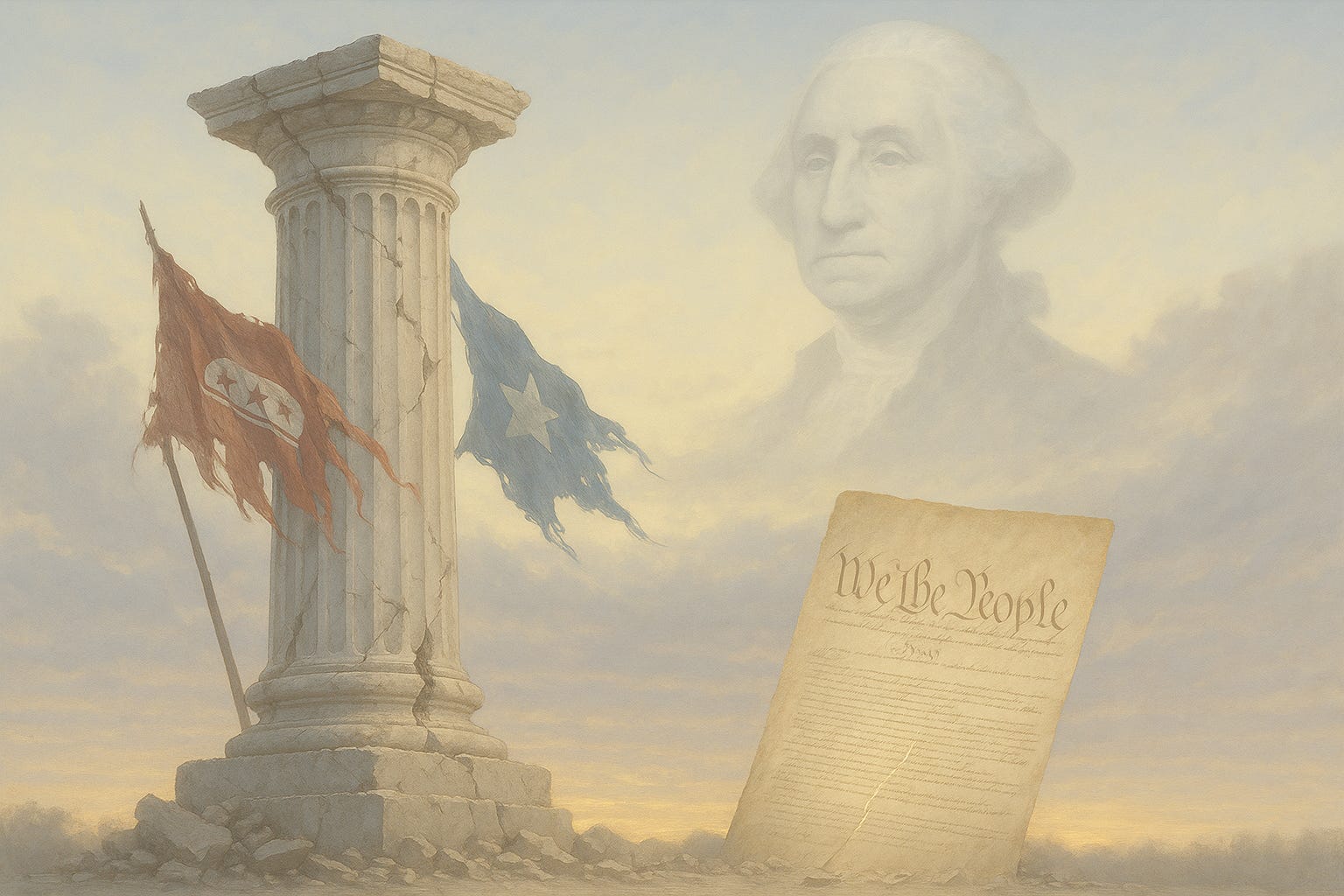
“It is not foreign enemies who most often undo a republic. It is factions at home, fueled by ambition and unchecked partisanship, that hollow out liberty from within.”
When Americans think of George Washington’s Farewell Address, many remember one line: his warning to avoid “foreign entanglements.” It is the phrase most often quoted in textbooks, speeches, and classrooms. Yet focusing only on that line misses the larger point of his address. Washington’s greatest fear was not foreign armies but domestic decay. He worried that partisanship, debt, and manipulative leaders would corrode the young republic from the inside. More than two centuries later, his concerns still feel strikingly current.
No matter how you subscribe, free or paid, thank you. Every reader matters, and your presence helps keep these conversations alive. Your support, whether through reading, sharing, or subscribing, makes all the difference.
Washington was not a naïve statesman. He had commanded an army against the most powerful empire of his age, presided over a fragile new nation, and seen firsthand how personal ambition and factionalism could tear movements apart. In his final message to the nation, he offered a sober reflection: America’s experiment in self-government would not be destroyed primarily by foreign adversaries. Instead, it would be undone if citizens allowed themselves to be divided into warring factions, exploited by “ambitious, and unprincipled men.”
The Forgotten Warnings
Much of Washington’s address centered on dangers at home. He recognized that political factions, once entrenched, would make citizens more loyal to party identity than to the Constitution or the republic itself. Parties would inflame passions, encourage rivalry, and create openings for demagogues. He described partisanship as a “fire not to be quenched” that, once unleashed, could consume liberty rather than preserve it.
Equally troubling for him was the threat of public debt. Washington saw debt not only as a financial burden but as a political liability. A government dependent on perpetual borrowing could be corrupted by creditors, weakened by mismanagement, and tempted into reckless spending that future generations would be forced to pay. In his mind, debt was as much about morality and civic responsibility as it was about numbers.
Faction as a Tool of Tyranny
Why was faction so dangerous? For Washington, it was because it could be weaponized by unscrupulous leaders. He warned of “unprincipled men” who would exploit party loyalty and public division for personal power. These men, he suggested, would rise not by uniting the people but by amplifying their divisions. The danger was not only political chaos, but the possibility that liberty itself would be sacrificed to ambition.
Debt as Political Weakness
The same logic applied to debt. Excessive borrowing, he believed, left the nation vulnerable. It created conditions where the public purse could be misused, where promises could be bought and sold, and where corruption could thrive. Washington did not oppose all debt—he knew emergencies required it—but he urged that it always be paid down in times of peace. A government perpetually in debt, he argued, was not only financially unstable but politically compromised.
Modern Echoes
If we turn from the 1790s to the present, Washington’s words read less like dusty history and more like prophecy. Partisanship today is not only a fact of political life, it has become a defining identity. Citizens increasingly sort themselves by party lines not just on policies, but on culture, geography, and community. Party loyalty often eclipses commitment to shared democratic norms.
Meanwhile, the United States has accumulated staggering national debt, used in part to finance wars, tax cuts, and bailouts. While debt is not inherently destructive, Washington’s concern resonates: who benefits from it, and how does it shape political choices? When fiscal policy becomes a tool of manipulation rather than stewardship, corruption and instability follow.
Unchecked Partisanship in Our Time
The most troubling echo of Washington’s warning is how modern factions have become weapons in the hands of ambitious leaders. We see politicians who thrive not by uniting the nation but by deepening division, framing opponents as existential enemies, and presenting themselves as the sole protectors of “real” Americans. The logic of faction has escalated into the politics of identity, and the constitutional framework designed to balance power is strained under its weight.
The Constitution at Risk
Washington knew that partisanship, debt, and unprincipled leadership were not minor flaws but existential risks. When liberty is sacrificed for party loyalty, when ambition is rewarded over principle, and when debt becomes a lever for corruption, the Constitution itself is endangered. His point was not to stifle political debate, but to ensure that debate did not harden into destructive tribalism.
Learning From the First President
Why does this matter today? Because Washington’s address is not simply a relic of the 18th century. It is a guidepost for the 21st. Democracy does not collapse only when armies invade or governments topple. It erodes quietly, hollowed out by factionalism, corruption, and the rise of leaders who would exploit both.
Remembering Washington’s warning is less about glorifying the past than about safeguarding the future. The republic, then and now, depends on citizens who prize unity over tribalism, responsibility over recklessness, and principle over ambition.
Conclusion
George Washington’s Farewell Address was not only a goodbye. It was a caution. He saw clearly that the gravest dangers to liberty come from within: partisanship that devours reason, debt that undermines responsibility, and leaders who exploit division for power. His words still stand as a mirror held up to our politics today. Whether we heed that warning remains our responsibility.