

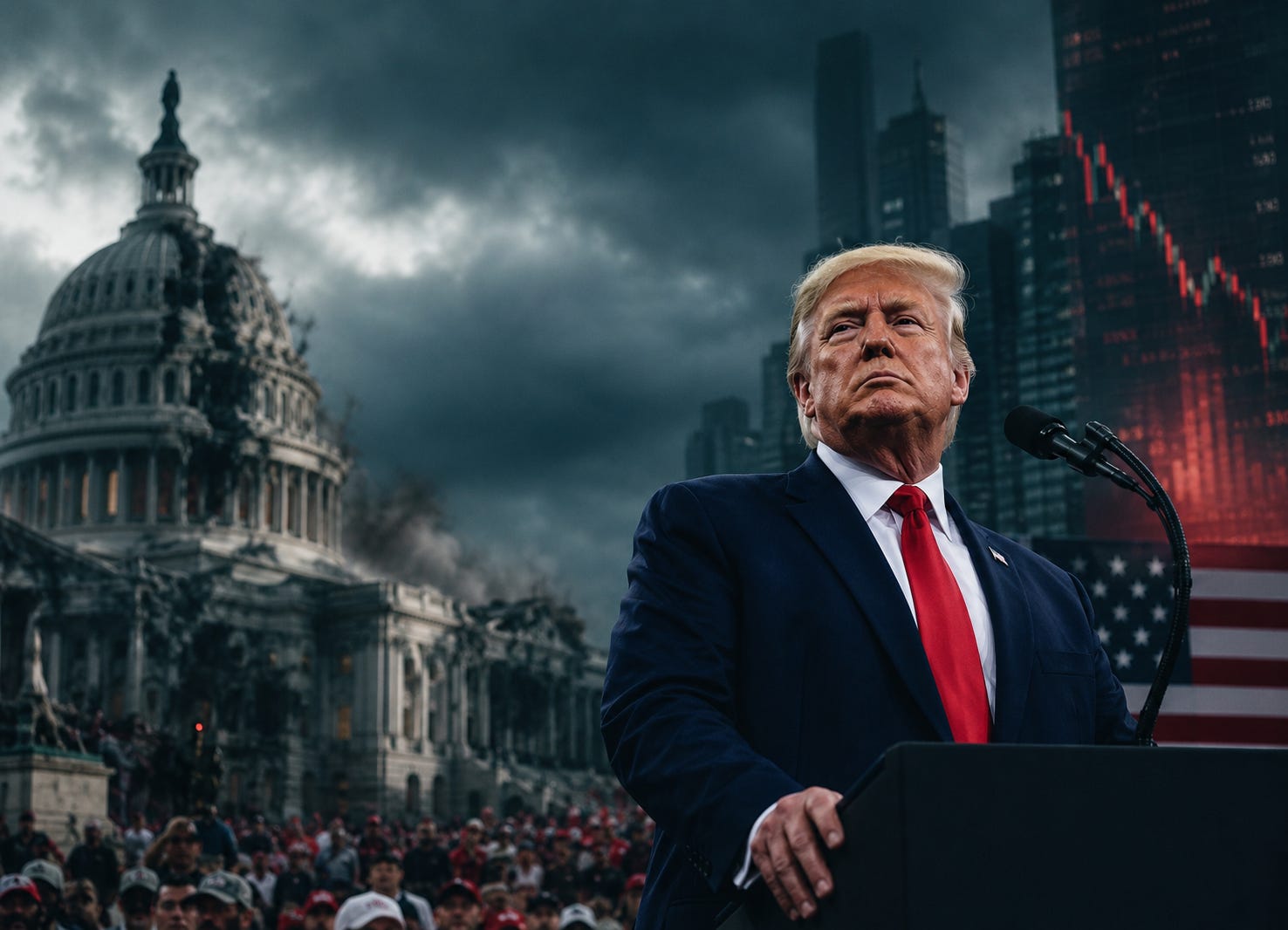
‘‘Trump did not corrupt an innocent system. He revealed a corrupted system without its manners.’’
The most dangerous illusion in American politics is the belief that Donald Trump represents a sudden break from the nation’s democratic tradition. That illusion is comforting because it makes the crisis seem temporary. Remove Trump, and America returns to normal. Defeat the man, and the republic heals. Push the fever down, and the patient recovers.
But Trump is not the cause. He is the effect.
He is the visible symptom of a deeper national disorder that has been spreading for decades. His authoritarianism did not arrive from nowhere. It grew from institutional decay, class betrayal, social abandonment, racial backlash, corporate propaganda, endless militarism, and the spiritual emptiness of a society organized around wealth extraction instead of human dignity.
Trump did not invent the corruption of American democracy. He exposed how advanced it had already become.
FREE for a limited time only: I Am Mike’s Ego
We are living through a political era in which ego is not just running the room, it is running campaigns, governments, media feeds, and millions of arguments before breakfast. I Am Mike’s Ego takes a funny, sharp look at the little dictator inside all of us, the voice that needs to be right, admired, obeyed, and occasionally elected. Timely, revealing, and free for a limited time. Read it before your ego decides it already knows everything.
For years, the political class told Americans that the system was working, even as factories closed, unions weakened, wages stagnated, communities were abandoned, prisons filled, medical debt exploded, and billionaires accumulated obscene fortunes. The public was told to believe in opportunity while watching the ladder get pulled up. They were told to trust institutions that no longer protected them. They were told democracy was healthy while both parties served donors before citizens.
That is the soil in which authoritarianism grows.
Authoritarian politics does not begin with a dictator on a balcony. It begins when ordinary people conclude that the existing order has no place for them. It begins when democratic institutions become hollow rituals, when elections change the managers but not the machinery, when public language loses contact with public suffering. It begins when cruelty is normalized by policy before it is performed as personality.
Before Trump made cruelty theatrical, American policy had already made it routine. Families were crushed by medical debt in the richest country on earth. Workers were told to be grateful for jobs that could not sustain them. Students were buried under loans for the privilege of entering an economy with no secure place for them. Black and brown communities were over-policed, underfunded, and then blamed for the conditions imposed upon them. The poor were lectured about responsibility by a ruling class that had turned fraud into a business model.
Trump did not create the moral vacancy at the center of American life. He occupied it.
His genius, if it can be called that, was never ideological depth. It was instinct. He understood that millions of Americans no longer believed the official story. He understood that resentment could be weaponized, humiliation could be redirected, and democratic despair could be turned into authoritarian loyalty. He did not heal the wound. He infected it. He took legitimate anger at a rigged system and aimed it downward, toward immigrants, minorities, women, journalists, teachers, civil servants, and anyone else who could be turned into a convenient enemy.
That is how authoritarianism works. It does not solve suffering. It gives suffering a target. It tells people who have been betrayed by power that their real enemy is someone even more vulnerable than themselves. It offers domination as a substitute for dignity. It replaces citizenship with tribal belonging. It tells the wounded that cruelty is strength, revenge is justice, and obedience is patriotism.
This is why treating Trump as an aberration is so dangerous. It allows the architects of decay to present themselves as defenders of democracy. It lets corporate Democrats, respectable Republicans, media elites, Wall Street donors, and military contractors pretend they had nothing to do with the conditions that produced him. It allows the country to mistake opposition to Trump for moral renewal.
But opposing Trump is not the same as rebuilding democracy.
A nation cannot be restored by nostalgia for the very order that made Trump possible. The polite consensus that preceded him was not healthy. It was merely better mannered. It wore nicer suits, spoke in softer tones, and used more respectable language while carrying out policies that hollowed out public life. It praised democracy while deregulating greed. It celebrated opportunity while preserving systems of exclusion. It invoked freedom while expanding surveillance, militarism, and corporate power.
Trump stripped the varnish off that order. He did not corrupt an innocent system. He revealed a corrupted system without its manners.
This is the great discomfort of the Trump era. He forces America to see itself without the flattering mythology. He shows us what happens when politics becomes pure branding, when celebrity replaces statesmanship, when wealth is mistaken for wisdom, when grievance becomes identity, and when power no longer feels any obligation to disguise its contempt.
He is the mirror held up to a nation that has worshipped domination while calling it success.
The deeper question, then, is not merely how America defeats Trump. The deeper question is whether America is willing to confront the society that diagnosed itself through him.
Because if Trump disappears tomorrow, the forces that made him possible will remain. The billionaires will remain. The donor class will remain. The propaganda networks will remain. The weakened labor movement, the privatized public sphere, the permanent war economy, the predatory health care system, and the resentment industry will remain. The machinery will remain, waiting for the next figure willing to operate it with fewer restraints and greater discipline.
That is the danger. Trump may be vulgar, chaotic, and personally grotesque, but the authoritarian future after him could be smoother, younger, colder, and more competent. The next version may not rant in all caps. It may speak calmly about order, efficiency, tradition, and national renewal.
That is why the work ahead cannot be limited to defeating one man.
America must recover a moral center large enough to challenge the system that produced him. That means rebuilding democracy not as a slogan, but as a lived reality. It means strengthening labor, protecting voting rights, breaking the power of oligarchy, defending public education, confronting white nationalism, demilitarizing civic life, and restoring the idea that government exists to serve human beings, not wealth.
It also means a spiritual reckoning. A society organized around extraction will eventually extract itself to death. It will consume its workers, its land, its communities, its truth, and finally its own democratic soul. No republic can survive when everything sacred is put up for sale.
Trump did not create that emptiness. He revealed it.
And until America understands that, it will keep treating the symptom while protecting the disease.
Before you go, tap the ❤️ and re-stack this post so we can put it in front of as many readers as possible.
I know some may not want to commit to a paid subscription, but if you’d like to support my work, you can always buy me a coffee on Ko-fi. Your contribution helps sustain independent writing rooted in consciousness, compassion, and social renewal. Every bit of support truly makes a difference.
Corruption is like cancer, it really matters at what point you address it. It’s really unwise to wait till stage four.
I can attest to Republican State Representatives discussing the benefit of a one party system. In that same time period I have had Corporate CEOs insisting that safety, working hours, pay and benefits was their business alone. They were hoping to return to the beginning of the 20th century when workers and the population at large deserved no rights. This is the same attitude of those who opposed the Ratification of the Constitution; people who argued for a dictatorship, theocracy, or monarchy. The underpinnings was the desire of governance that would have no restrictions on unlimited capitalism. As long as they sat at the top.