
The Babel Tower We Build Within
Artificial intelligence will either reveal our moral maturity or magnify our spiritual confusion

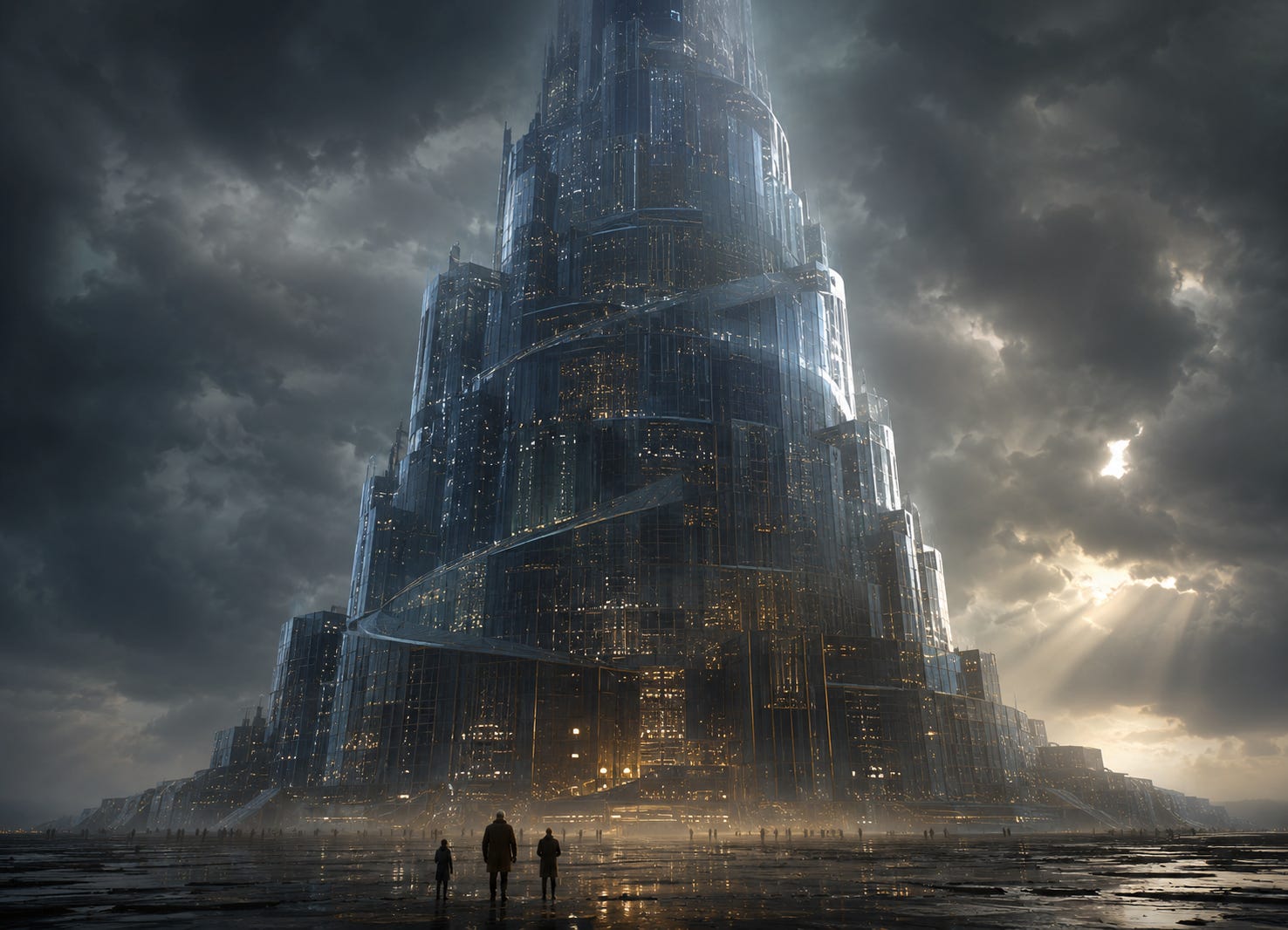
‘‘Artificial intelligence is not the enemy. The danger is unawakened humanity with godlike tools, building from fear, greed, and domination instead of wisdom, justice, compassion, and reverence.’’
Pope Leo’s warning yesterday about artificial intelligence and the Tower of Babel is more than a religious metaphor. It is a diagnosis of the human condition in technological form. His argument is not that AI is evil, nor that discovery should stop, nor that the human mind should retreat from invention. His warning is subtler and more necessary. A civilization can become so intoxicated by its own powers that it forgets the consciousness from which those powers arise. When that happens, technology does not elevate humanity. It amplifies our disorder.
The Tower of Babel story has endured because it speaks to a recurring human temptation. We discover a new capacity, gather around it with excitement, then mistake height for wisdom. We build upward without first building inward. We measure progress by reach, scale, speed, and control, while neglecting the qualities that make progress humane: compassion, restraint, humility, justice, reverence, and responsibility.
That is why the Pope’s concern deserves serious attention, even from those outside his tradition. His warning is not merely Catholic commentary. It is a universal moral alarm. Technology is not inherently evil, but neither is it morally weightless. It carries the consciousness of those who design it, fund it, regulate it, and use it. Every tool emerges from a field of intention. Every system reflects an order of values.
That may be the most important point in the entire debate. AI is not some alien force descending upon humanity from outside creation. It is an expression of us. It carries our brilliance, our curiosity, our creativity, and our longing to understand. It also carries our greed, fear, haste, domination, and willingness to reduce living beings to functions. The machine mirrors the maker.
This is why the AI crisis is not finally a technical crisis. It is a crisis of consciousness, meaning a crisis in the inner condition from which our outer systems are built. A fearful society will build fearful machines. A greedy society will build extractive machines. A violent society will build automated violence. A spiritually confused society will build systems that confuse information with wisdom, simulation with presence, and power with progress. A humane society, if it becomes disciplined enough to do so, can build tools that serve life rather than diminish it.
We are not merely asking what artificial intelligence can do. We are asking what kind of beings we are becoming as we use it. Will we use it to deepen wisdom, relieve suffering, expand education, protect life, and make the burdens of human existence lighter? Or will we use it to replace workers, manipulate desire, flood the world with falsehood, automate violence, concentrate wealth, and strip human beings of agency?
Those questions cannot be answered by engineers alone. They cannot be answered by investors alone. They cannot be answered by military planners, corporate executives, or political strategists alone. They require moral imagination. They require spiritual seriousness. They require a vision of the human person that cannot be reduced to productivity, consumption, data, or control.
The Pope is right to worry about concentration of power. A technology that touches language, labor, education, war, art, commerce, intimacy, and truth itself cannot be left in the hands of a few private actors whose governing obligation is shareholder return. When artificial intelligence is shaped primarily by profit, it will naturally reproduce the values of profit: extraction, acceleration, dependency, market capture, and the conversion of human attention into revenue. That is not a moral accident. It is the logic of the system expressing itself through the machine.
This is why regulation alone, though necessary, is not enough. Laws can restrain abuse, require transparency, limit dangerous applications, and protect the public from the worst forms of exploitation. But law cannot substitute for a transformed moral imagination. A society that worships profit will always find ways to baptize extraction as innovation. A society that worships power will always describe domination as security. A society that worships speed will always confuse the faster thing with the better thing.
The danger deepens when artificial intelligence enters the domain of war. A tool that helps doctors detect disease is one thing. A tool that helps states identify, track, and kill human beings is another. When a society allows machines to select targets, manage surveillance, shape public perception, or govern access to opportunity, it is not simply adopting tools. It is delegating moral authority. It is allowing systems without conscience to mediate human destiny.
There is a profound difference between using intelligence and surrendering judgment. There is a difference between assistance and abdication. AI can help identify patterns, organize information, model possibilities, and support human decision-making. But it cannot bear moral responsibility. It cannot love. It cannot repent. It cannot stand before the suffering person and understand the sacredness of the life in front of it.
The danger is not that AI will become too human. The greater danger is that human beings will become too mechanical.
We already see signs of this. Workers are discussed as inefficiencies. Children are treated as data markets. Artists are treated as style libraries. Teachers are pressured to compete with automated instruction. Writers are told that language itself can be mass-produced without soul. Soldiers and civilians may soon be placed under the shadow of algorithmic warfare. Public truth is increasingly vulnerable to synthetic images, simulated voices, automated propaganda, and manufactured consensus.
The issue is not whether AI can produce something impressive. It can. The issue is whether we will still know the difference between output and wisdom, imitation and presence, efficiency and care, calculation and conscience.
A humane civilization must insist that persons are not problems to be optimized. A child is not a data point. A worker is not a cost center. A patient is not a diagnostic probability. A citizen is not a behavioral profile. A soldier is not a target signature. A community is not a market segment. A human being is not a bundle of predictable responses.
Every real moral tradition, whether religious or secular, begins somewhere near this truth: life has value beyond utility. The person is more than the measurable self. The deepest qualities of human existence are not always the most profitable, scalable, or programmable. Love is inefficient. Mercy is not always strategic. Beauty cannot be fully quantified. Forgiveness cannot be automated. Presence cannot be downloaded.
This does not mean rejecting technology. It means restoring order. Tools must serve life. Knowledge must serve wisdom. Power must serve compassion. Innovation must serve the common good. The outer structure must be governed by the inner law.
The Tower of Babel was not condemned because people built. It was condemned because they built from confusion, pride, and domination. They sought unity through uniformity. They sought transcendence through height. They sought security through control. They confused collective ambition with spiritual maturity.
That is exactly the danger in the AI age. We may build a global system that speaks one digital language while losing the deeper language of the heart. We may connect everything and commune with nothing. We may automate knowledge and forget wisdom. We may create systems that appear intelligent while the society that deploys them becomes morally asleep.
The alternative is not fear. It is awakening.
AI could help humanity if governed by a higher vision. It could support medical research, environmental restoration, disability access, language translation, education, climate modeling, and the reduction of drudgery. It could become a tool for human flourishing, but only if we refuse to make it an idol. It must be held within ethics, democracy, transparency, labor rights, ecological responsibility, and reverence for the human person.
The question is not whether artificial intelligence has a place in the future. It does. The real question is whether the future will have room for the soul.
The Pope’s warning should be heard as a call to return to first principles. A civilization cannot be saved by intelligence alone. Intelligence without love becomes manipulation. Intelligence without humility becomes domination. Intelligence without justice becomes exploitation. Intelligence without truth becomes propaganda. Intelligence without conscience becomes violence.
The deepest work before us is not merely to regulate machines, although we must. It is to regenerate the moral center from which we build them. We must ask not only what AI can make possible, but what kind of world we are consenting to create through it. We must ask who benefits, who is harmed, who decides, who is silenced, who is replaced, and who is made invisible.
The Tower of Babel is not ancient history. It is a pattern in the human mind. It rises whenever power outruns wisdom. It rises whenever ambition separates itself from love. It rises whenever humanity tries to master the world without first mastering its own fear, greed, and illusion.
We can build differently.
We can build systems that honor workers rather than discard them. We can build platforms that strengthen truth rather than dissolve it. We can build tools that expand human capacity rather than replace human dignity. We can build governance that treats technology as a public concern, not a private empire. We can build with humility, knowing that not every possible thing is a rightful thing.
The Pope is right to sound the alarm. Not because AI is the enemy, but because unawakened humanity with godlike tools is a danger to itself.
The future will not be decided by machines alone. It will be decided by the consciousness we bring to them. If we build from fear, greed, and domination, we will build Babel again. If we build from wisdom, justice, compassion, and reverence, we may yet build a world worthy of the intelligence we have been given.
The real test of artificial intelligence is not whether machines can think.
It is whether human beings still can.
Before you go, tap the ❤️ and re-stack this post so we can put it in front of as many readers as possible.
I know some may not want to commit to a paid subscription, but if you’d like to support my work, you can always buy me a coffee on Ko-fi. Your contribution helps sustain independent writing rooted in cons
Sources
Vatican News: Pope Leo XIV releases first encyclical on artificial intelligence
Reuters: Pope Leo urges world to slow down AI fervor in first manifesto
Thank you Michael for this timely and brilliantly succinct article about artificial intelligence.
Thank you for drawing attention to Pope Leo’s Encyclical on AI, and the difference between human and artificial intelligence, namely the essentially human task of remaining in charge of what we require AI to do for us, so that moral choices can be made. Moral choices are much more than quickly processing information, and include sentience and soul. In simple terms, doing the right thing, guided by our shared humanity.
It is not every man for himself, nor every machine for itself, but rather that we are all in this together.
Can we please put all these considerations of AI into one key context?
That is, in all our world, there are no schools with essaying programs so students may probe the growth of other students as individuals in other cultures.
It takes skills to see others as individuals, and then to quote them (directly and indirectly). Students can first equip themselves with these skills in home classrooms. They can start with intro essays identifying themselves by the shifts in their styles of food, clothing, shelter from what they originally got from family and community to personal changes they then made. (Shelter may include interior design, exterior landscapes, and travel modes there.)
Students can learn first to analogize to fellow classmates in those home classrooms. Then send batches of eventually revised essays to peer classroom in another culture.
No one learns any literacy as basically decently human as this anywhere in the world because what Michael here calls moral growth, human dignity, humility, and spiritual maturity give way everywhere to the standardized testing and the corporate-packaged textbooks that value instead all being neutered, grouped, categorized, and commodified.
AI can work wonders with the latter type of "person," as its metrics are all most easily numbered, counted, and machine graded.
The latter, our ubiquitous dehumanized standards only, govern all schools -- even the Pope's.