
The Declaration Still Points America Forward
How America’s founding promise still calls us toward equality, justice, and democratic renewal

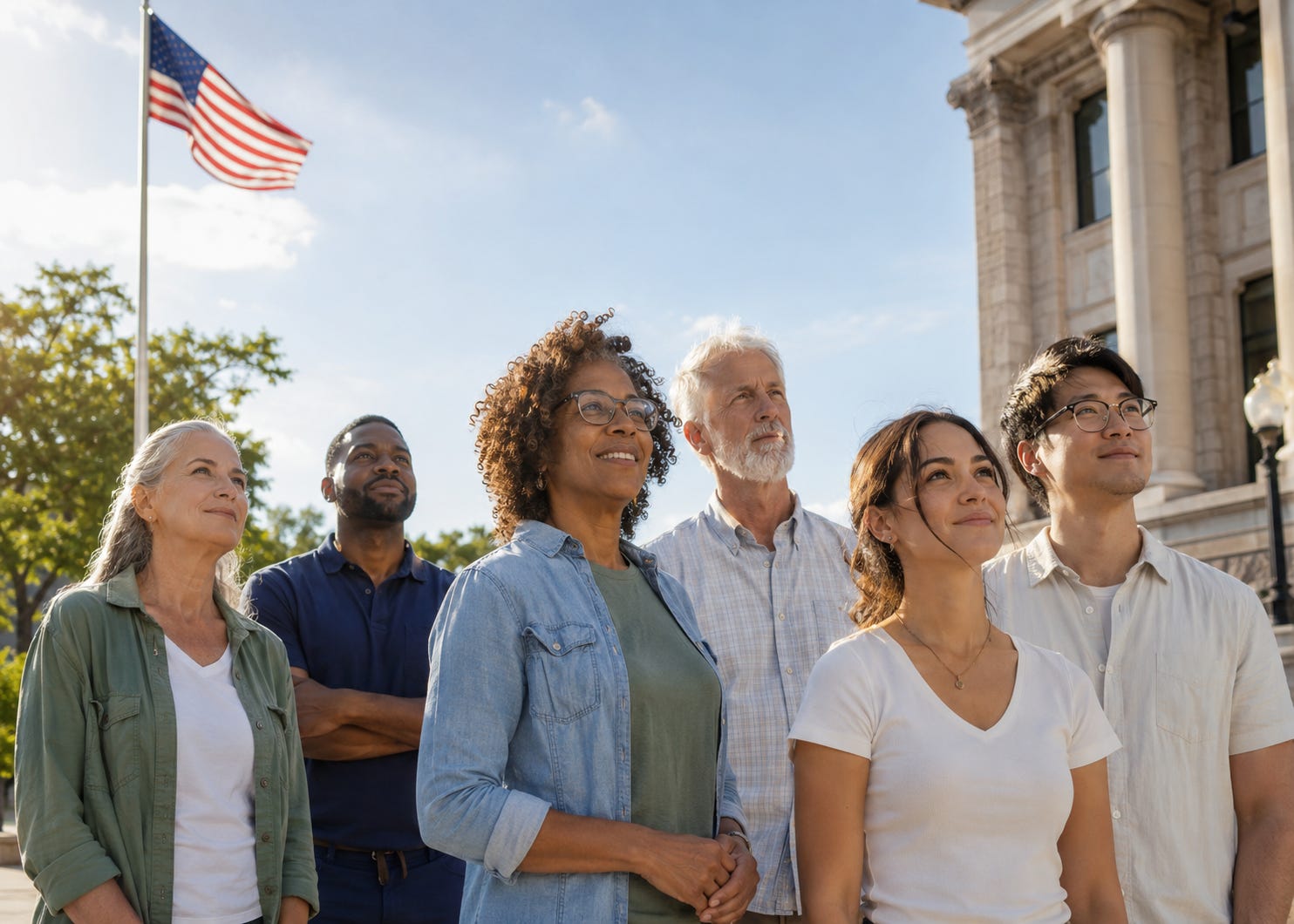
“The work before us is not to worship the past, but to redeem its best promise.”
The Original Promise
The Declaration of Independence is not merely a founding document. It is America’s original promise, and also its enduring test. Its power does not come from the perfection of the men who signed it. They were limited by their age, and often by their own contradictions. Its power comes from the fact that they put into words a principle larger than themselves: that all people possess rights no government may justly deny.
That idea remains revolutionary. The Declaration says government exists to secure life, liberty, and the pursuit of happiness, and that its authority depends on the consent of the governed. In plain terms, government is not sacred. People are. Institutions are legitimate only when they protect human dignity and serve the public good. That is the heart of the American experiment, not blind loyalty to power, but moral accountability from power.
Renewal Is Fidelity
This is why the seeds of America’s present renewal are already contained within the Declaration. When citizens call for equal justice, honest elections, living wages, bodily freedom, racial equality, climate responsibility, safe communities, and a democracy that answers to people instead of wealth, they are not rejecting America. They are calling America back to its deepest stated purpose. They are saying that the founding promise was never meant to remain frozen in the hands of a few, but to unfold more fully in every generation.
The Declaration’s language has always been bigger than the nation’s practice. That tension is painful, but it is also the source of America’s moral progress. Abolitionists appealed to its promise when they denounced slavery. Suffragists appealed to its promise when they demanded the vote. Labor organizers appealed to its promise when they fought against exploitation. Civil rights leaders appealed to its promise when they confronted segregation and racial terror. Each movement exposed the gap between America’s words and America’s realities, and each movement forced the country to ask whether it truly believed what it claimed to believe.
A Braver Patriotism
That is why renewal is not betrayal. Renewal is fidelity. To renew America is not to sneer at its founding ideals, nor is it to worship the founders as though history ended in 1776. It is to take the Declaration seriously enough to measure the nation by its own highest words. A country that declares equality must confront inequality. A country that declares rights must protect the vulnerable. A country that claims government rests on consent must defend voting rights, fair representation, and public trust. A country that speaks of happiness must care about whether ordinary people can live with dignity, health, safety, and hope.
The Declaration also gives us a hopeful kind of patriotism. It does not ask us to pretend the nation has been pure. It asks us to believe that the nation can be corrected. That is a braver love than nostalgia. Nostalgia often wants a past polished clean of conflict. Hope looks at the full truth and still chooses repair. It says the American story is not finished, and that the next chapter can be more humane than the last.
The Promise Remains Unfinished
This matters especially now, when many people feel exhausted by division, distrust, and cruelty in public life. The Declaration reminds us that democracy is not merely a system of offices and elections. It is a moral relationship among people who recognize one another as equal in worth. It asks us to build a society where freedom is not reserved for the powerful, where rights are not bargaining chips, and where government does not become an instrument of domination.
America does not need renewal because its founding promise failed. It needs renewal because that promise remains unfinished. The Declaration gave us the language of equality, consent, accountability, and human flourishing. Our task is to give those words fuller life. We can do that through courage at the ballot box, honesty in public debate, solidarity with the vulnerable, and a refusal to confuse cynicism with wisdom.
The work before us is not to worship the past, but to redeem its best promise. The seeds were there from the beginning. Equality was there. Liberty was there. Accountability was there. The pursuit of happiness was there. Now we must cultivate those seeds with wider compassion, firmer justice, and democratic faith. America can still become more fully itself, not by looking backward with fear, but by moving forward with conscience.
Thank you for reading. Before you go, tap the ❤️ and re-stack this post so we can put it in front of as many readers as possible.
I know some may not want to commit to a paid subscription, but if you’d like to support my work, you can always buy me a coffee on Ko-fi. Your contribution helps sustain independent writing rooted in consciousness, compassion, and social renewal. Every bit of support truly makes a difference.