
The Axe We Call Progress
Why the Systems We Trust Are Cutting Us Down


“Humanity is the tree that embraces the axe, comforted by the familiar grain of the handle and blind to the sharpened edge.”
That line is not decorative. It is diagnostic.
The most dangerous forces shaping our future do not present themselves as threats. They arrive as quarterly earnings, campaign slogans, product launches, and patriotic appeals. They speak the language of growth, freedom, and security. They look like us. That is precisely the problem.
Start with global warming. Fossil fuels powered the rise of modern prosperity. They electrified cities, expanded transportation, and helped lift billions into industrial economies. Growth became synonymous with progress. Yet we now know that continued fossil fuel combustion drives rising global temperatures, intensifying wildfires, flooding coastal cities, and destabilizing food systems. We passed 1.5 degrees Celsius of warming in monthly averages. Entire regions are becoming harder to insure, harder to farm, harder to inhabit.
The handle looks like jobs, mobility, and national strength. The blade is atmospheric destabilization. We defend the system because it built our comfort, even as it undermines the conditions for long-term survival.
The pattern extends beyond energy. Disposable plastics made life cheaper and more convenient. Now microplastics are found in oceans, wildlife, drinking water, and human blood. Fast fashion accelerates trends and reduces cost, while textile waste piles up in landfills and waterways across the Global South. Industrial animal agriculture delivers inexpensive protein at scale, while contributing significantly to methane emissions, antibiotic resistance, deforestation, and water pollution.
Each system answers a real desire: affordability, speed, familiarity. Each carries costs that are externalized, meaning someone else pays. The handle is convenience. The blade is cumulative ecological damage.
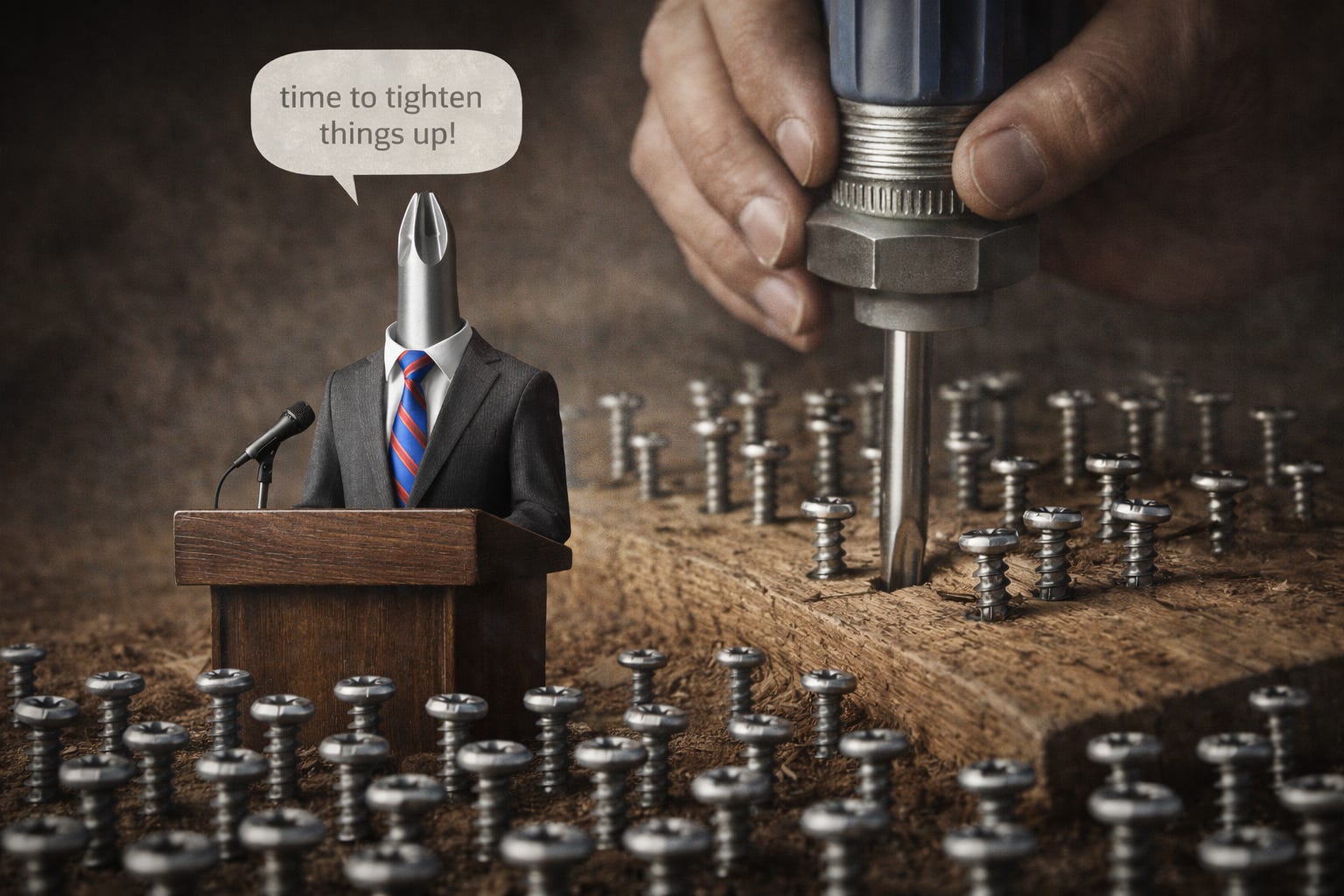
In the digital sphere, the illusion grows subtler. Social media promised connection and democratized speech. Instead, engagement-driven algorithms reward outrage and amplify misinformation because anger keeps users scrolling. Surveillance capitalism monetizes attention, tracks behavior, and predicts preferences at scale. What is sold as personalization often functions as behavioral shaping.
The handle feels like community and empowerment. The blade erodes shared reality and civic trust. Democracies depend on a common set of facts. When that foundation fractures, polarization hardens and governance becomes brittle.
Even democracy itself can become vulnerable to the same dynamic. Authoritarian populism rarely declares itself openly. It speaks in the language of restoration and pride. It identifies enemies, promises order, and frames institutional safeguards as obstacles. Citizens frustrated by economic anxiety or cultural change may support leaders who mirror their grievances. Over time, independent courts, free press protections, and minority rights can be weakened in the name of efficiency or strength.
The handle is identity and belonging. The blade is the slow erosion of democratic norms.
What binds these examples together is not random failure. It is structure. For decades, public policy and corporate governance have been guided by shareholder primacy, the doctrine that a corporation’s primary obligation is to maximize shareholder value. Under this framework, environmental stability, public health, and long-term resilience become secondary if they conflict with short-term return.
When profit maximization becomes the governing metric, extraction accelerates. Forests become timber inventories. Attention becomes data. Communities become markets. War becomes contract flow. Health becomes a revenue stream. The handle is prosperity. The steel edge is unrestrained extraction.
There is an uncomfortable truth embedded in the metaphor. The axe handle is made from the tree itself. These systems were not imposed by foreign invaders. They were built by our labor, defended by our votes, and normalized by our consumption. Retirement funds are tied to market performance. Cultural status is tied to accumulation. Convenience is tied to supply chains we rarely examine.
We are not passive victims. We are participants in structures that reward short-term gain over long-term survival.
Language softens the impact. We call deregulation freedom. We call fossil fuel expansion energy independence. We call data extraction innovation. We call permanent military readiness security. The vocabulary blunts the edge. By the time consequences become visible, they appear accidental rather than predictable.
The metaphor of the tree is not fatalistic. It is a warning about discernment. Tools are not inherently destructive. Energy systems can be renewable. Technology can be accountable. Markets can be regulated. Governance can be strengthened. But familiarity must not replace scrutiny.
The defining mistake of our era is confusing what is familiar with what is safe.
Humanity does not have to remain the tree that embraces the axe. Recognition is the turning point. Once we acknowledge the blade, we can redesign the tool. We can measure success by long-term stability rather than quarterly growth. We can prioritize ecological limits, democratic resilience, and shared well-being over extraction without boundaries.
The blade is not hidden. We simply prefer the comfort of the handle to the responsibility of seeing clearly.
And that preference, if left unchallenged, will determine whether the tree survives the swing.
I know some may not want to commit to a paid subscription, but if you’d like to support my work, you can always buy me a coffee on Ko-fi. Your contribution helps sustain independent writing rooted in consciousness, compassion, and social renewal. Every bit of support truly makes a difference.
“Recognition is the turning point. Once we acknowledge the blade, we can redesign the tool.
We can measure success by long-term stability rather than quarterly growth.”
— Yes, and we obviously must, in order to survive. Looking far into the future I really wonder which of the modern conveniences will remain with us, some will remain with various degrees of alteration, others may be done away with completely.
It really depends on who takes charge, how and when. Trump & his admin are ‘in it’ for a quick buck & hardly look beyond the next stock market readout, polling result or election. They & those they enable are wealthy enough to ride out the ecological disasters with relative ease, compared to we, the ‘huddled masses’, awaiting FEMA assistance that often comes too little, too late … and increasingly, not at all.
* For those inclined to the scriptures: “I will bring to ruin those ruining the earth” (Rev. 11:18)
- and “The righteous will possess the earth, and they will live forever on it.” (Psalm 37:29)
provide some hope from our Creator.
“And I saw a new heaven and a new earth; and the former heaven and the former earth had passed away, and the sea is no more.” Rev. 22:1.
(‘sea’ = boisterous humanity rebelling, and for good reason).