
Prosperity Should Make Dignity Ordinary
A society is not truly prosperous until its wealth becomes health, education, beauty, security, ecological care, and shared public good.

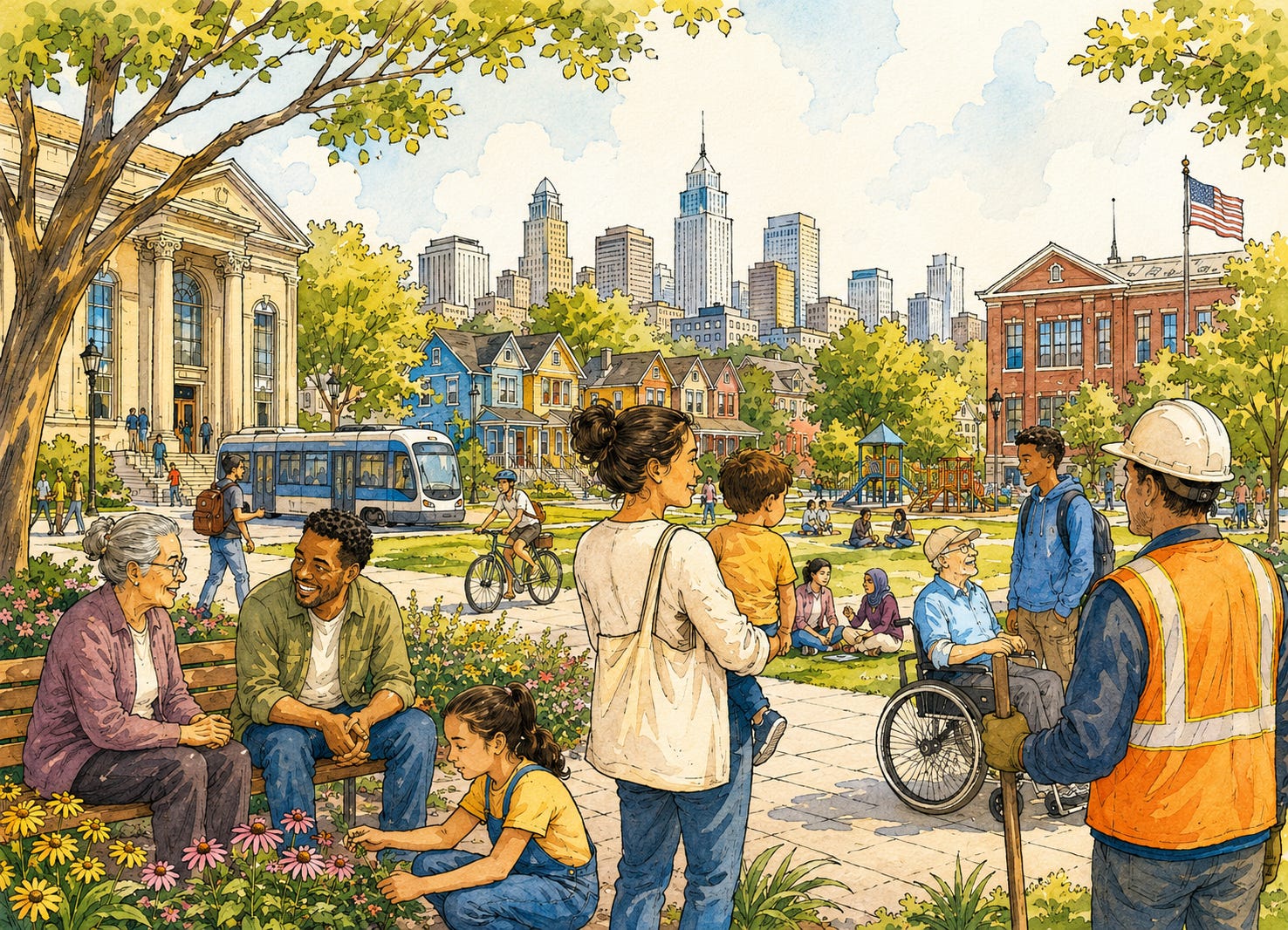
‘‘The purpose of prosperity is not simply to produce more goods, bigger fortunes, or more powerful markets. Its purpose is to make a humane civilization possible.’’
Prosperity is one of the most misunderstood words in American public life. Too often, it is treated as a synonym for wealth, production, profit, or the steady expansion of markets. A prosperous nation, we are told, is one with a rising stock market, strong corporate earnings, high productivity, and expanding consumer choice.
Those things may indicate economic activity, but they do not answer the deeper question. They do not tell us whether people are living well. They do not tell us whether communities are whole, whether children are nourished, whether workers are secure, whether elders are cared for, or whether the land itself is being protected.
The real question is not whether a society can generate prosperity. The real question is what prosperity is for.
Prosperity is not for accumulation alone. It is not permission for a few to pile up wealth while the many are told to be grateful for survival. It is not moral cover for an economy that rewards speculation more than care, ownership more than labor, and private excess more than public good.
Prosperity, if it is to mean anything worthy of a democratic people, must be for the enlargement of human life.
The Moral Measure of an Economy
A prosperous society should give people more than the right to compete. It should give them the conditions in which life can actually flourish. That means time, health, security, education, beauty, rest, and meaningful work.
It means children who do not go to school hungry. It means elders who do not spend their final years in fear of abandonment. It means workers who are not exhausted into numbness. It means families who are not living one medical bill, one layoff, one rent increase, or one broken-down car away from disaster.
This is where the moral measure of an economy becomes clear. An economy is not successful simply because it produces wealth. It is successful when that wealth reduces suffering, expands freedom, and strengthens the common life.
If prosperity does not improve the lives of ordinary people, it is not prosperity in any meaningful social sense. It is merely concentration. It is wealth without wisdom, growth without justice, abundance without mercy.
Public Wealth and Human Flourishing
At its best, prosperity is the material foundation for moral, cultural, intellectual, and spiritual development. It allows people to do more than survive. It gives them room to think, create, worship, question, learn, love, organize, rest, and participate in democracy.
A person crushed by precarity may still have courage, imagination, and faith, but constant insecurity steals time and attention. It narrows the horizon. It makes life smaller than it should be.
A genuinely prosperous society understands this. It builds libraries, schools, parks, clinics, museums, public transit, clean water systems, safe housing, and accessible public spaces. It protects clean air, forests, rivers, and farmland because nature is not a luxury outside the economy. Nature is the living ground beneath every economy.
It supports art, music, scholarship, science, journalism, and public culture because a democracy cannot live by consumption alone. It needs memory, beauty, truth, imagination, and shared meaning.
This is the difference between consumer abundance and civic abundance. Consumer abundance gives people more things to buy. Civic abundance gives people a world worth living in.
Prosperity and Democracy
Prosperity is also for democracy. A nation of desperate people is easy to manipulate. When people are economically trapped, they are more vulnerable to fear, resentment, scapegoating, and authoritarian promises. They may be told that their suffering is caused by immigrants, minorities, intellectuals, public servants, or some invented enemy within.
In that way, concentrated wealth and widespread insecurity become political dangers. They do not merely produce hardship. They weaken the civic fabric.
A democratic society needs citizens who have enough stability to think clearly, speak freely, and participate meaningfully. That requires more than formal rights. A person may technically have the right to vote, speak, assemble, and dissent, but if they are working three jobs, drowning in debt, unable to access health care, and terrified of losing housing, their freedom has been hollowed out.
Prosperity should give democracy the social foundation it needs to be real.
This was the moral imagination behind the best parts of the New Deal and the Great Society. They were not perfect, and they were never fully completed, but they understood something our own age has tried hard to forget: public policy is not just a budgetary exercise. It is a statement of what a society believes human beings are worth.
A Society Worth Living In
The purpose of prosperity cannot be reduced to private comfort. Private comfort matters, but it is not enough. A society can have luxury towers, gated communities, elite universities, private hospitals, and exclusive cultural institutions while millions live in neglect. That is not civilization. It is a partitioned society.
True prosperity is shared, not because everyone must have the same life, but because everyone deserves a dignified one. It does not require sameness. It requires justice. It asks whether the wealth of a society is being used to deepen human possibility or to decorate inequality. It asks whether abundance is being translated into public good or locked away as private power.
If prosperity does not deepen justice, it becomes decoration on a cruel system. If it does not reduce suffering, it becomes hoarding. If it does not protect the vulnerable, it becomes privilege. If it does not honor the Earth, it becomes theft from the future.
The purpose of prosperity is not simply to produce more goods, bigger fortunes, or more powerful markets. Its purpose is to make a humane civilization possible.
Prosperity is for life. It is for dignity, democracy, beauty, community, ecological care, and the full flowering of human potential.
Prosperity is not the end of politics. It is the test of politics. It asks whether we have built a society worthy of the people who live in it.
Before you go, tap the ❤️ and re-stack this post so we can put it in front of as many readers as possible.
I know some may not want to commit to a paid subscription, but if you’d like to support my work, you can always buy me a coffee on Ko-fi. Your contribution helps sustain independent writing rooted in cons
Beautifully stated.
Many good observations here, and an eye-opener follow-up question:
— “It asks whether we have built a society worthy of the people who live in it.”
And in America’s current exaggerated socioeconomic pyramidal structure … some are still ‘believers’ that extreme wealth makes you right, bigger, better people … even some poorer people believe/ adulate this vision.
America (and the world, to varying degrees) has for too long venerated wealth & status.
— to the point where we are being dragged by a self-aggrandizing snake oil salesman ‘off the cliff’ and back into a new age of feudalistic serfdom.
At the rate things are going, in the coming decade the U.S. may not be much different than Russia - except for outward appearances due to past advances - perhaps we should learn to cook borscht & more potato & onion-based dinners now? (Healthier than some of our insta-meals anyway).
There are so many ways the Trump admin is dragging us back to the bad old days & ways.
💎 “Keep your eyes open and guard against every sort of greed, because even when a person has an abundance, his life does not result from the things he possesses.” Luke 12:17