
March 28, 2027
One Year After “No Kings III,” America’s Democratic Renewal Is the Story That Changed the World

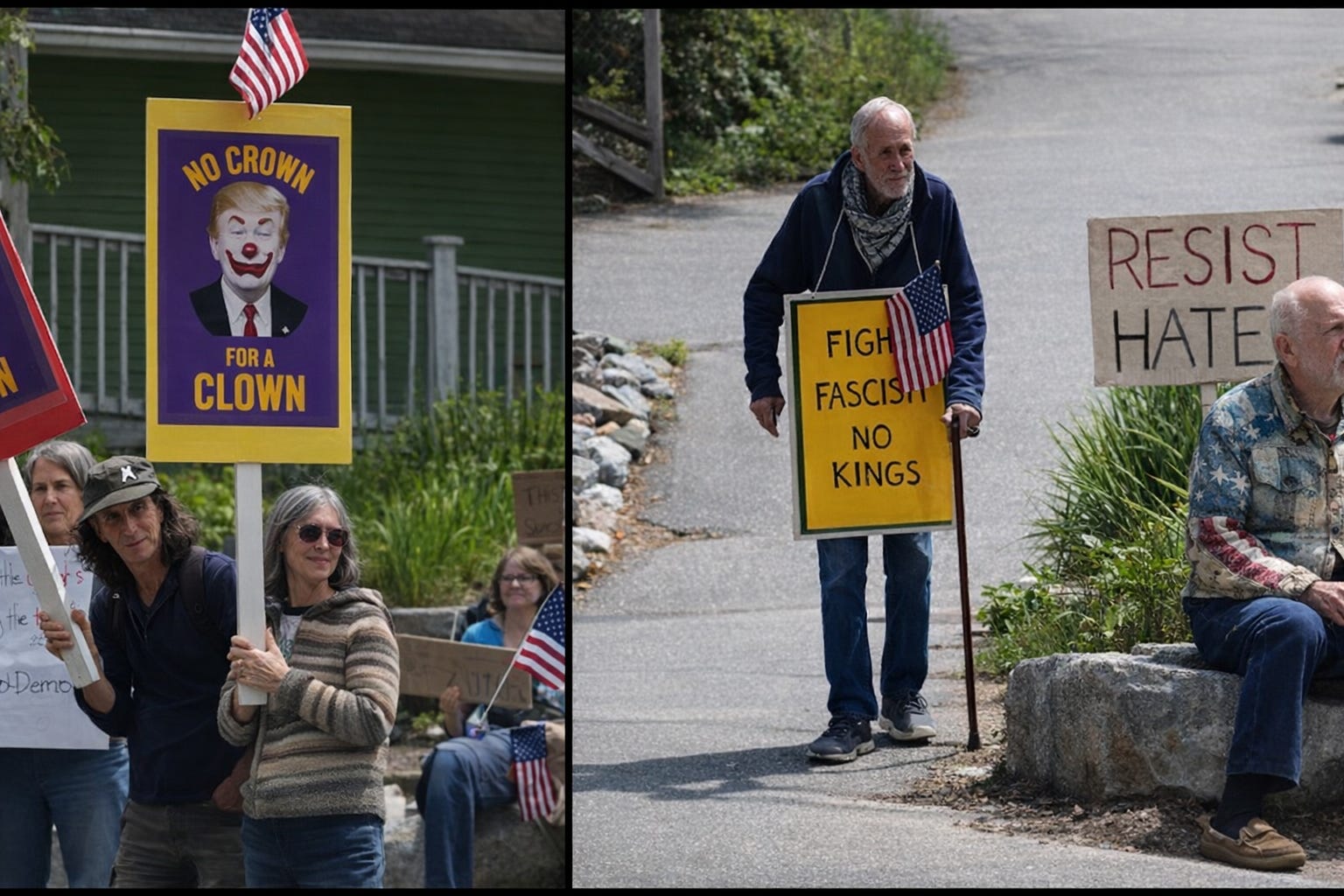
“A democratic people, battered but not broken, remembered that self-government is not a ceremony. It is a discipline.”
One year ago today, Americans filled streets, parks, courthouse steps, college quads, church lawns, and downtown squares under a message so simple it cut through every layer of noise: No Kings.
At the time, it was easy to treat the rallies as one more day of protest in an age crowded with protest. The country had been living for months inside a climate of strain and dread. Trump had returned to power in January 2025. By early 2026, many Americans were watching an old pattern harden into something more dangerous: the weakening of democratic life without its formal abolition. Elections still took place. Courts still issued rulings. Congress still convened. Newspapers still published. But law was growing more uneven, public institutions more humiliated, and political power more openly tied to spectacle, intimidation, and wealth.
The fear was not only that democracy was under pressure. It was that the public might grow used to the pressure.
Then came March 28, 2026.
What happened that day now looks, in retrospect, like the turning point of the year. The No Kings rallies did not fix the republic in an afternoon, and they did not pretend to. What they did was break the atmosphere of inevitability that authoritarian politics depends on. In city after city, and in towns far from the usual centers of national attention, Americans saw that resistance was not scattered after all. It was broad. It was disciplined. It was morally awake. Most of all, it was not alone.
That mattered because strongman politics feeds on isolation. It wants citizens to believe that everyone else has already given in, that public courage is marginal, that democratic principle is too weak and too late to matter. No Kings interrupted that script. It made visible a democratic majority that had been hidden, in part, from itself.
The signs were homemade. The crowds were multiracial, multi-generational, and strikingly local. Veterans stood beside students. Teachers marched with union members. Black church networks, immigrant rights groups, librarians, suburban mothers, civil libertarians, climate activists, and disillusioned conservatives found themselves in the same civic frame. The point was larger than opposition to one man. It was a public refusal of the idea that the country should be governed through fear, theatrical domination, and personal rule.
That was the day many Americans stopped waiting to be rescued by institutions already under strain. They began to act like custodians of a democracy that would survive only if they helped carry it.
Over the next twelve months, that shift in public feeling became something more durable. Protest became organization.
Volunteer lists turned into precinct networks. March routes became canvassing maps. Group chats became voter registration drives, legal defense teams, school board coalitions, poll worker recruitment efforts, and local democracy campaigns. Young organizers brought speed, reach, and fluency with digital mobilization. Older civic networks brought stamina, memory, and trust. Faith communities moved from witness to action. Labor groups connected democratic rights to workplace dignity. Teachers, librarians, and local officials, already under pressure, became defenders not only of their professions but of civic truth itself.
This is where the story changed.
For much of 2025 and early 2026, the dominant mood in political commentary was exhaustion. Every abuse seemed to crowd out the last one. Every fresh outrage arrived before the public had absorbed the previous one. Many Americans were still trapped in a cycle of alarm without structure. No Kings did not create the country’s democratic conscience, but it did help convert that conscience into machinery.
By summer, the effects were visible.
The shift was not confined to the activist left, and that is one reason it held. The center of gravity moved in suburbs, swing counties, and local institutions where politics is often less theatrical and more decisive. Voters who had once hoped that Trump’s return would somehow burn itself out came to see that democratic repair would require deliberate effort. Many moderate and independent voters stopped treating Trumpism as a normal partisan episode and began seeing it for what it was: a civic threat.
Women were central to that shift. In suburbs and metro regions across the country, they responded not only to policy extremism but to the moral texture of the political order itself, its contempt for restraint, its addiction to humiliation, its treatment of public cruelty as strength. Young voters changed the map too, not through romantic slogans alone, but through disciplined turnout. They had grown up in a time when democracy no longer looked permanent, and many acted with the seriousness of people who understood that rights can be lost.
Black voters, once again, gave the country some of its deepest democratic clarity. Through churches, local organizations, neighborhood networks, and long practice in reading the gap between American promise and American behavior, Black communities helped anchor turnout and moral focus. They understood what much of the broader political culture had to relearn: that democracy is not secured by sentiment. It is secured by participation, protection, memory, and organized pressure.
By the time the 2026 midterms arrived, the election had become more than a referendum on Trump himself. It was a referendum on the governing style that had deepened since his return: selective law, elite impunity, institutional degradation, and the steady demand that the public accept instability as normal.
The results were decisive.
The blue wave that followed was not only large. It was clarifying. Democrats won back the House with force, made major gains in governorships and state legislatures, and strengthened pro-democracy offices at the state level, especially in positions tied to elections, law enforcement, and constitutional oversight. Even in places where Republicans held on, the old aura of inevitability was broken. The country did not look conquered. It looked contested, and then corrected.
That correction did not solve everything. No serious person would say it did. A republic strained for two years cannot be restored in one election cycle. But the midterms changed the balance of civic power. They reintroduced something essential into public life: consequences.
Oversight began to matter again. Hearings began to matter again. Documentation, subpoenas, testimony, public record, and institutional friction all returned to the center of national politics. The House, newly under Democratic control, became a site of counterpressure rather than performance alone. That procedural change had moral significance. In degraded democracies, one of the most damaging civic experiences is watching abuse move in only one direction. Citizens begin to assume that intimidation will always pay, corruption will always be absorbed, and law will always arrive too weakly or too late. What changed after November was not the end of impunity, but the end of its total rhythm.
Congress did not accomplish that alone. It was possible only because other parts of the democratic order had held long enough for politics to catch up.
Judges had held. Election workers had held. Journalists had held. State officials had held. Teachers, librarians, nonprofit advocates, local reporters, career civil servants, volunteer lawyers, and ordinary citizens had held. None of that was glamorous. Much of it was exhausting. But democracies are rarely saved by purity or brilliance. They are saved when enough people refuse surrender long enough for the public to intervene.
That is what happened in the United States over the past year, and it changed more than domestic politics.
A year ago, allies were quietly preparing for the possibility that the United States was entering a longer period of democratic and strategic unreliability. That concern was real, and justified. America’s drift toward authoritarian-style politics had global consequences. It shook alliances. It emboldened strongmen. It weakened the moral authority of democratic criticism abroad. It suggested that corruption, spectacle, and cruelty were becoming normalized even in the most powerful constitutional republic on earth.
The events of the past year did not erase that damage. But they changed the lesson.
America’s allies now see not only a troubled government, but a democratic people still capable of self-correction. They have seen mass mobilization, electoral accountability, and institutional recovery emerge from a public many had feared was too fragmented or demoralized to act. That matters beyond the United States. Democratic decline can be contagious, but so can democratic recovery. The American example now carries a different message than it did a year ago.
The message is not that democracies repair themselves automatically. They do not. It is not that institutions are invulnerable. They are not. It is not even that the danger has passed. It has not.
The message is that decline is not destiny.
That may sound like a modest claim, but after the past several years it is a profound one. The darkest political systems depend not only on force, but on fatalism. They rely on the belief that the public is too divided, too tired, too distracted, or too cynical to act in time. What the United States demonstrated over the past year is that a democratic society can still surprise its would-be rulers. It can still rediscover solidarity. It can still turn fear into structure, and structure into power.
That is why the anniversary of No Kings matters.
The rallies did not save the country by themselves. The midterms did not heal it by themselves. The institutions did not preserve it by themselves. The story is larger and more democratic than that. Millions of people decided that the republic was not somebody else’s responsibility. They chose to protect election systems, rebuild local civic life, defend public truth, persuade their neighbors, endure the boredom of organization, and show up when it counted.
They changed the mood of the country first. Then they changed its trajectory.
One year later, the biggest political story in America is no longer only the danger that Trump posed by returning to power in January 2025. It is the answer the country gave after March 28, 2026. A democratic people, battered but not broken, remembered that self-government is not a ceremony. It is a discipline.
The work ahead remains difficult. Oligarchic power has not vanished. Disinformation has not vanished. The authoritarian appetite for spectacle, grievance, and domination has not vanished. American democracy remains vulnerable to all the forces that weakened it in the first place. But the past year established something the country and the world urgently needed to see: the slide was not irreversible.
A year after No Kings III, the defining fact of American politics is no longer the strength of one would-be ruler.
It is the rediscovered strength of a people who decided they did not want one.
Before you go, tap the ❤️ and re-stack this post so we can put it in front of as many readers as possible.
I know some may not want to commit to a paid subscription, but if you’d like to support my work, you can always buy me a coffee on Ko-fi. Your contribution helps sustain independent writing rooted in consciousness, compassion, and social renewal. Every bit of support truly makes a difference.
Fiction and wishful thinking... I admire your optimism BUT IT WILL NOT END LIKE THIS... RIP OFF THE RAINBOW COLOURED GLASSES... only a white person could write this drivel
I loved the No Crown for the Clown sign!!