
"I HATE"
A Heart Laid Bare: What Trump’s Words Reveal About America’s Future

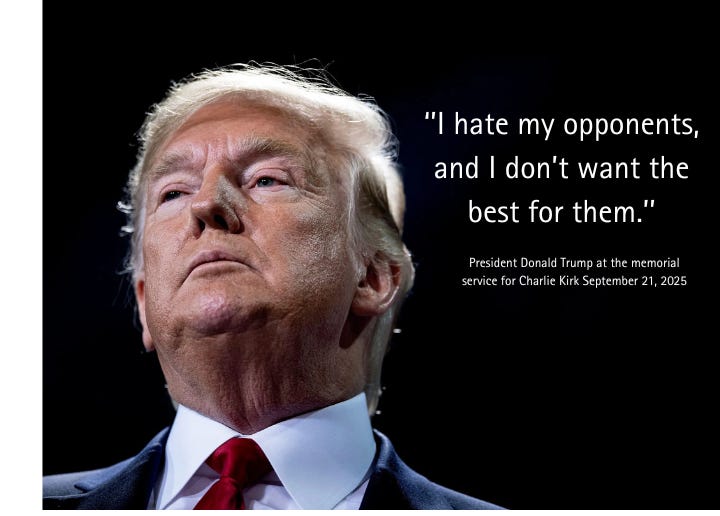
Trump’s remark stripped away the usual polish of political rhetoric, revealing how he truly views his opponents. It is a stark confession that raises profound ethical and civic questions about America’s path forward.
Donald Trump’s statement at Charlie Kirk’s memorial — “I hate my opponents, and I don’t want the best for them” — is more than a passing remark. It speaks to an erosion of civic values that once anchored American democracy.
Delivered in a moment meant to honor a life and offer solace, the comment instead foregrounded division, resentment, and the normalization of contempt for political adversaries. From a perspective rooted in human rights, ethics, and high moral standards, this is cause for serious concern about the direction of our public life.
Democratic societies depend on a baseline of respect among those who disagree. The right to speak, to assemble, and to advocate for competing visions of the common good only survives when opponents are not cast as enemies to be despised. Trump’s words undermine that principle. They suggest that politics is a zero-sum contest where one must not only defeat rivals but also deny them dignity. That approach corrodes the possibility of dialogue and renders compromise nearly impossible.
Human rights frameworks emphasize the inherent worth of every person, regardless of belief or affiliation. Ethical traditions across cultures teach that we owe one another fairness, even when we disagree profoundly. A leader who dismisses these norms signals to followers that cruelty is acceptable, that empathy is weakness, and that moral restraint is optional. When such rhetoric comes from a former president and current candidate, its impact is magnified: it sets a tone for millions, reshaping what is seen as normal or permissible in political discourse.
History shows that contempt for opponents often precedes erosion of liberties. When leaders encourage followers to view dissenters as people undeserving of goodwill, the ground is prepared for measures that strip them of rights. Democratic backsliding does not begin with tanks in the streets; it begins with the steady framing of “the other side” as unworthy of inclusion. Trump’s language hints at that trajectory. It suggests a future where public debate is less about persuasion and more about punishment.
There is also an ethical dimension to consider. In times of grief, the role of a public figure is to console, to elevate, to remind us of shared humanity. To use a memorial to declare hatred is to invert that moral expectation. It turns a ritual of remembrance into a platform for grievance, which not only disrespects the bereaved but cheapens the civic culture we rely upon to process loss together.
The future of America will depend on whether its people insist on higher standards. Citizens, journalists, educators, and faith leaders have an opportunity to reaffirm that disagreement need not cancel compassion. We can choose leaders who model self-control and moral clarity instead of spite. We can support institutions that foster dialogue across divides. And we can remind one another that human rights are not conditional on ideology.
Trump’s remark was a warning about how far discourse can fall when ethics are discarded for applause lines. If America is to preserve a republic where freedom and dignity flourish, it must reject the politics of hatred and reclaim the civic virtues — empathy, fairness, and moral responsibility — that sustain a just and pluralistic society.