
From Backlash to Breakthrough: How the Trump-MAGA Era Could Give Birth to a Deeper American Democracy
Commentary

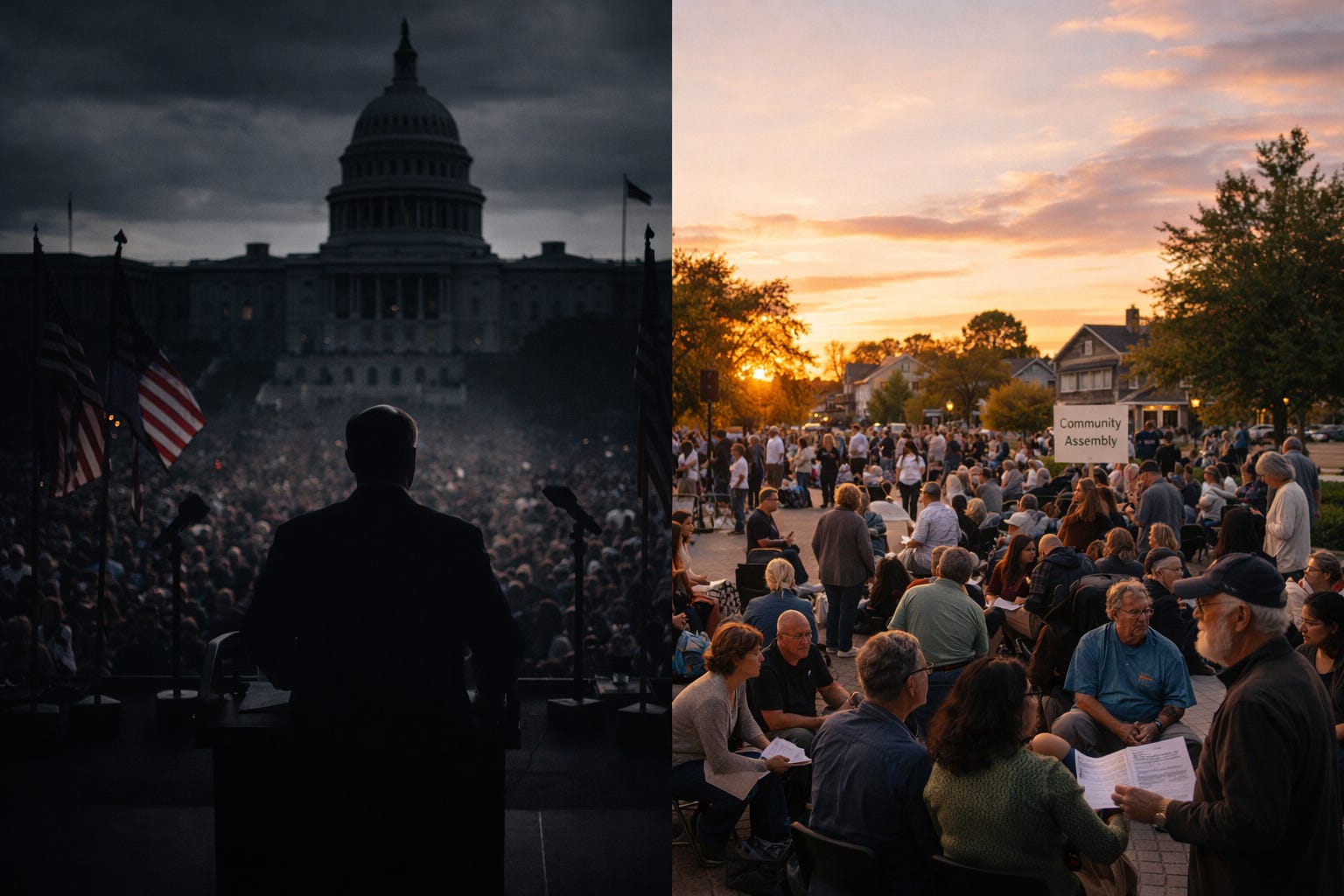
Some political movements believe they are building a permanent order when, in fact, they are helping bring a new one into view.
That is one of the clearest lessons of American history. The Confederacy did not see itself as a doomed rebellion. Its leaders believed they were establishing a political future grounded in hierarchy, exclusion, and permanent inequality. Yet history remembers that era not as the triumph of the Confederacy, but as the crucible in which the nation was forced to redefine itself. Out of civil war came constitutional transformation. Out of a politics of domination came a stronger claim for democratic equality.
The Trump-MAGA era may become a similar rupture.
At present, it looks like a period of democratic breakdown. It has normalized political cruelty, glorified ignorance, weakened public trust, and treated pluralism as a threat rather than a strength. It has fused strongman theater with oligarchic interests and wrapped both in the language of grievance. It has encouraged millions of Americans to see democratic limits not as safeguards, but as obstacles to conquest.
But history does not always preserve the ambitions of reactionary movements. More often, it records the deeper transformation those movements unintentionally provoke.
It is possible, then, that the Trump-MAGA era will produce not only a stronger democratic America but a more mature one. It may force the country to confront a truth long ignored: defending democracy is not enough if democracy remains too thin, too centralized, and too vulnerable to capture by wealth and media power.
The crisis did not begin with Trump. He exposed it, accelerated it, and exploited it. The underlying weaknesses were already there.
For decades, American democracy has been hollowed out by concentrated power. Wealth has pooled upward. Corporate influence has expanded. Public institutions have grown more remote from everyday life. Citizens have been trained to think of democracy as something they perform occasionally at the ballot box rather than practice as an ongoing responsibility. The result is a system that is formally democratic, but substantively weak.
That weakness created fertile ground for authoritarian politics.
When people feel powerless, alienated, and economically insecure, they become vulnerable to movements that promise force, simplicity, and revenge. When the government seems distant and unresponsive, demagogues can present themselves as the only authentic voice of the people. When public life is dominated by money, media spectacle, and elite insulation, democracy begins to look like a shell rather than a living civic order.
That is why going back to the pre-Trump status quo is not a serious answer.
Restoration has its place. Institutions matter. Norms matter. The rule of law matters. But restoring an earlier version of American liberalism without addressing the deeper structural failures that made Trumpism possible would mean rebuilding the same vulnerable house on the same unstable foundation.
What is needed is not only democratic defense, but democratic deepening.
A stronger post-MAGA America may need to become a participatory democracy in a far more serious sense. That means moving beyond the narrow idea that citizens fulfill their political role mainly by choosing leaders every two or four years. Voting is essential, but it is not sufficient. Democracy becomes real when people have meaningful, ongoing power to shape the conditions of common life.
That requires decentralization.
A decentralized participatory democracy would push power downward and outward into communities, councils, assemblies, regional bodies, and local institutions. It would give ordinary people a larger role in decisions that directly affect their lives, including housing, education, energy, food systems, land use, transportation, local development, and public investment. Participatory budgeting, for example, allows residents to directly decide how public funds are spent. Community land trusts give neighborhoods a durable way to shape development and protect housing from speculative extraction.
This is not a call for chaos or fragmentation. It is a call for democratic distribution of authority.
Centralized systems tend to accumulate power far from everyday life. Whether political, economic, or informational, they create bottlenecks where elites can dominate decisions that affect millions. In such systems, citizens are often left with little more than symbolic participation. They are asked to consent, react or complain, but not truly govern.
Decentralization changes that relationship. It creates structures in which democratic life becomes active rather than passive. It invites citizens to become participants rather than spectators. It restores civic muscle that centralized systems allow to atrophy.
Still, political decentralization by itself is not enough.
A democratic society cannot remain healthy while its economy is organized around extraction, artificial scarcity, and private accumulation. Political power and economic power are never fully separate. If a handful of corporations and wealthy interests control the material conditions of life, democratic participation will always be constrained by economic dependence. A politics of shared power cannot endure on top of an economy built for concentrated control.
This is where Resourceism becomes essential.
Resourceism offers an economic vision that matches the democratic logic of decentralization. It starts from the premise that the Earth’s resources are not mere commodities to be owned, exploited, and hoarded for private gain. They are a shared inheritance, the material basis of life itself, and should be stewarded accordingly. In that framework, the economy is no longer organized around profit maximization, but around meeting human needs, preserving ecological balance, and ensuring fair access to life’s essentials. In practice, that would require new public and cooperative institutions capable of planning, stewarding, and distributing essential resources transparently across local, regional, and larger democratic scales.
Just as participatory democracy decentralizes political power, Resourceism decentralizes economic stewardship.
It shifts the governing principle of society away from ownership and accumulation and toward shared responsibility. It imagines a system in which food, water, shelter, health care, energy, and other essentials are treated as guarantees of civilization rather than prizes in a competitive struggle. It insists that the purpose of economic life is not to enrich a few, but to sustain the many within the limits of a living planet.
This matters because authoritarianism feeds on insecurity.
When millions of people are economically precarious, when housing is unstable, health care is expensive, wages are weak, and survival feels contingent, fear becomes politically useful. Demagogues weaponize that fear. They redirect frustration away from systems of concentrated wealth and toward scapegoats, migrants, minorities, intellectuals, dissenters, and the vulnerable. Economic anxiety becomes cultural rage. Social fragmentation becomes easier to manage from above.
A more decentralized and participatory democracy, paired with a resource-based system of shared stewardship, would attack those conditions at their root.
It would not only expand political voice. It would expand material security. It would not only ask people to participate more. It would make participation more realistic by reducing the desperation and exhaustion that keep people locked out of public life. It would treat democracy not as an abstract right floating above the economy, but as a lived condition supported by the structure of economic life itself.
That is why participatory democracy and Resourceism belong together.
Participatory democracy without economic transformation remains fragile. It can be overridden by money, distorted by private control, and reduced to consultation without power. Resourceism without democratic participation risks becoming managerial or technocratic. It could become something administered for people rather than governed by them.
Together, they form a more coherent answer.
One disperses political authority. The other disperses economic power. One gives people a direct role in collective decision-making. The other provides the material foundation for a more equal, stable, and ecologically sane society. One strengthens citizenship. The other strengthens the conditions under which citizenship can flourish.
Seen this way, the Trump-MAGA era may eventually be understood as a catalyst rather than a conclusion.
Its damage is real. Its cruelty is real. Its danger is real. But crises clarify what ordinary times allow people to ignore. Trumpism has exposed the instability of a democracy too dependent on norms, too penetrated by wealth, too vulnerable to lies, and too detached from the daily lives of its own citizens. It has shown how easily centralized power can be manipulated when civic life is weak and economic life is already organized for concentration.
That exposure may prove historically productive if Americans are willing to learn from it.
The task ahead is not simply to defeat authoritarian politics at the ballot box, though that remains necessary. The larger task is to build a social order in which authoritarianism has less room to thrive. That means making democracy more participatory, more local, more continuous, and more real. It means making the economy less extractive, less unequal, and less governed by profit alone.
In that sense, the future worth seeking is not a restoration of the old republic in cleaner clothes. It is the maturation of the republic into something more distributed, more humane, and more resilient.
The question before America is no longer whether it can return to normal. The old normal helped produce this crisis. The real question is whether it can grow beyond a democracy that is procedural but thin, and toward one that is decentralized, participatory, and materially grounded in the common good.
If it can, then the Trump-MAGA era may one day be remembered not as the chapter that ended American democracy, but as the convulsion that forced it to become more fully itself.
Before you go, tap the ❤️ and re-stack this post so we can put it in front of as many readers as possible.
I know some may not want to commit to a paid subscription, but if you’d like to support my work, you can always buy me a coffee on Ko-fi. Your contribution helps sustain independent writing rooted in consciousness, compassion, and social renewal. Every bit of support truly makes a difference.
We are being given a 'civics' lesson front stage and center. How many will hear the political message and internalize the economic one?
Excellent article... beautifully written. At this point, the concept of Resourceism ( which was a new term to me) seems almost a necessity for any social order if the planet is to survive. I don't have my own substack to restack this article... I wonder if there is a way to print it from your substack.. It would be a good article to hand out to people on March 28. Thank you for sharing this article...