
Floating Authoritarian Fantasies: Trump, Putin, and the Alaska Trial Balloon
How a “slip of the tongue” rehearses imperial ambition in the American imagination

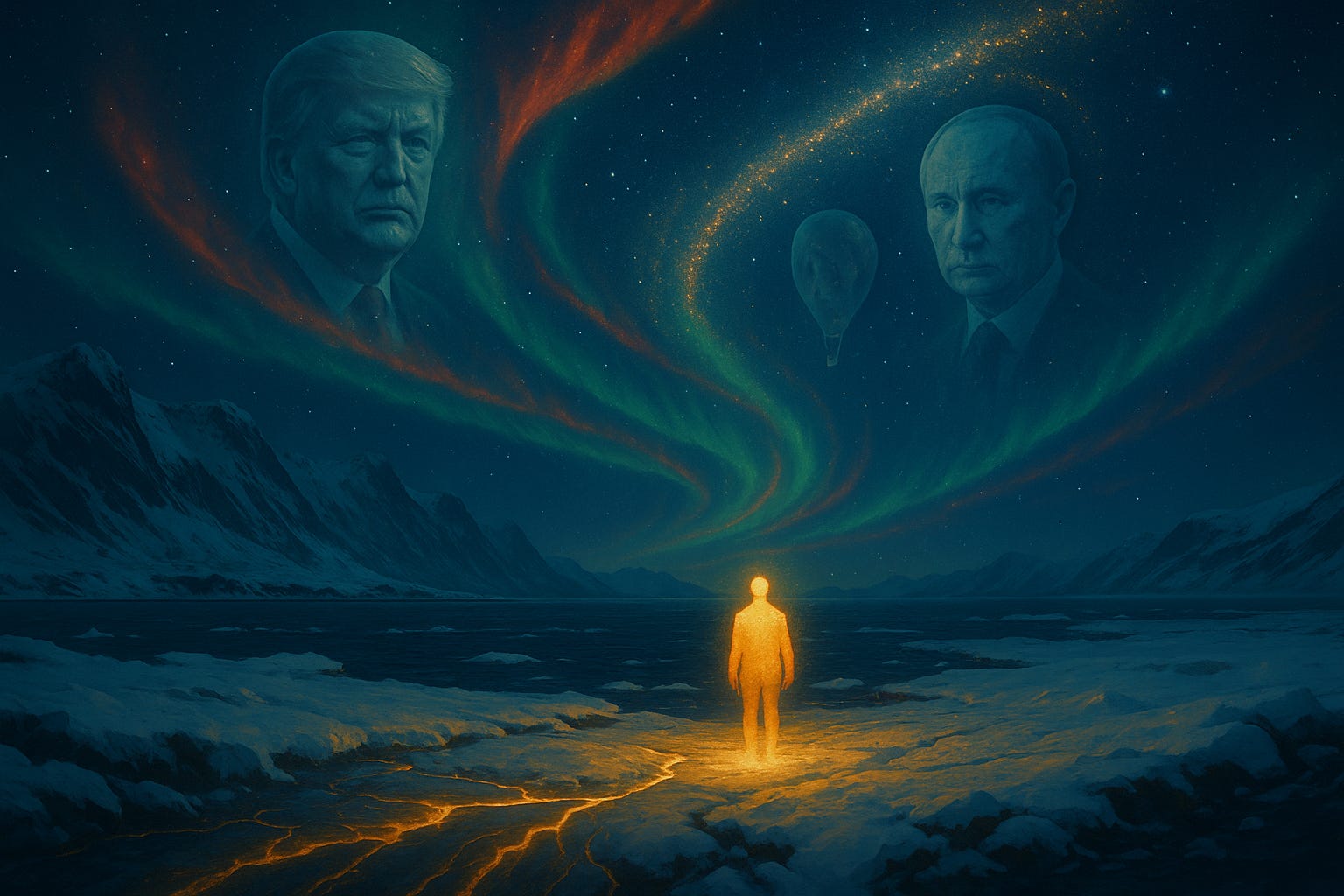
“I’m going to Russia,” Trump declared in the days before his meeting with Vladimir Putin in Anchorage, Alaska. He said it repeatedly. And with those words, he blurred a geopolitical boundary that is not supposed to be up for debate.
The so-called Trump–Putin “summit” yesterday in Alaska was never really about diplomacy. No significant agreements were signed, and no binding policies emerged. What it offered, instead, was political theater. On Putin’s side, it was an imperial stage play. On Trump’s side, it was another attempt to reframe the American imagination around authoritarian possibilities.
“An outrageous idea is floated, seemingly as a slip of the tongue, for an audience of hundreds of millions, then re-introduced and circulated when the time is right until it becomes accepted.”
— Ruth Ben-Ghiat, The Make Russia Great Again “Summit”
As historian Ruth Ben-Ghiat observed, Trump’s repeated use of “I’m going to Russia” was not simply a verbal stumble. It was what she calls a trial balloon. By misnaming Alaska as Russia, Trump floated a balloon that implicitly normalized the Kremlin’s imperial aspirations. He conjured the fantasy of Russia regaining control of Alaska, while the United States, in this shared imperial vision, might swallow Canada and Greenland in return. All of these territories, as Ben-Ghiat notes, are resource-rich lands with immense strategic value.
This is not just the stuff of rhetorical accident. It is the machinery of authoritarian imagination.
Alaska and the Imperial Dream
To understand why Alaska matters, we need to look at both history and geography. Alaska was Russian territory until 1867, when the United States purchased it for $7.2 million. At the time, critics called it “Seward’s Folly,” mocking Secretary of State William H. Seward for buying what they saw as a frozen wasteland. Today, it is clear just how shortsighted those critics were. Alaska is one of the most resource-rich regions of the world, with vast reserves of oil, gas, minerals, and rare earth elements.
Alaska is not just land, it is leverage — the keystone of America’s Arctic presence.
For Putin, reclaiming Alaska would represent the ultimate reversal of humiliation, the undoing of a historic concession. For Trump, treating Alaska as quasi-Russian is a way to indulge authoritarian fantasy and flatter his political partner. When he says “I’m going to Russia” instead of “I’m going to Alaska,” he is not merely careless. He is signaling. He is blurring sovereignty in a way that legitimizes Putin’s worldview.
The Arctic as the New Frontier
Climate change is melting sea ice, opening up new shipping lanes and access to natural resources. The Arctic holds an estimated 13 percent of the world’s undiscovered oil and 30 percent of its undiscovered natural gas, along with vast quantities of minerals like nickel, copper, and rare earth elements essential for the technologies of the future.
Russia has moved aggressively to militarize and exploit this region. It has built Arctic military bases, invested heavily in icebreakers, and positioned itself as the dominant Arctic power. China, calling itself a “near-Arctic state,” has begun its own incursions, seeking a foothold in shipping routes and mineral extraction.
The Arctic is the 21st century’s new frontier of empire — and Alaska is the entry point.
For the United States, Alaska is the keystone of its Arctic presence. Losing or diminishing its symbolic claim to Alaska would mean ceding enormous leverage in one of the world’s most important strategic zones. This is why Trump’s “slip” is not innocent. It plays directly into Kremlin propaganda, in which Russia is the rightful master of the Arctic, and America is an interloper.
The Trial Balloon as Propaganda
Ruth Ben-Ghiat’s concept of the trial balloon helps us see the deeper function of these rhetorical slips. Trump has used this tactic again and again. He floats something shocking—ending birthright citizenship, delaying elections, jailing opponents—and waits to see how people respond. If the reaction is muted, the idea re-enters the discourse, this time less shocking. Over time, what once seemed outrageous becomes thinkable.
Authoritarianism does not arrive with a bang. It seeps in through repetition.
By calling Alaska “Russia,” Trump contributes to this conditioning. He primes his audience to imagine Alaska as potentially Russian territory, a place where sovereignty is negotiable. It is a fantasy today, but fantasies have political power. They shape what people believe is possible.
The Partnership of Authoritarian Storytelling
What makes this even more dangerous is that Trump and Putin are not simply adversaries. They are partners in political theater. Putin gains international legitimacy when he appears alongside the U.S. president as an equal. Trump gains validation for his personal narrative that he is above the “deep state” and traditional U.S. institutions. Together, they rehearse authoritarian dreams on the global stage.
When Trump indulges Putin’s fantasies, he imports them into the American imagination.
When Trump indulges Putin’s imperial imaginary, he helps normalize it for American audiences. When Putin stands next to Trump, he projects strength to Russians at home. It is a mutually beneficial exchange of political capital. The costs, however, fall on democracy itself.
From Ukraine to Alaska: The Imperial Continuum
We should not see Alaska in isolation from Ukraine. Both belong to the same imperial continuum. Putin’s war is about restoring what he sees as Russia’s rightful empire. Alaska, in that logic, is simply another lost territory.
Ukraine and Alaska are two chapters in the same imperial script.
Trump’s role is not to deliver Alaska, but to normalize the idea that borders are fluid, that authoritarian bargains can redraw maps, and that resource-driven imperialism is a legitimate aspiration.
Why Language Matters
Some will dismiss this as nitpicking, as taking Trump’s words too seriously. But language is never neutral in politics, especially when wielded by an authoritarian-minded leader. Authoritarianism thrives on slips, jokes, and “just asking questions.”
Words are the rehearsal stage of authoritarian power.
It advances not only through policies and tanks but also through rhetoric that shifts the imagination of what is possible.
This is why we must treat Trump’s Alaska “slip” as a serious act of political speech. It is a signal to Putin, a nod to imperial ambition, and an experiment on the American psyche.
What Is at Stake
At stake is more than Alaska. At stake is the principle of sovereignty, the future of the Arctic, and the resilience of democracy in the face of authoritarian creep.
When Trump plays with imperial fantasies, he is not only flattering Putin. He is conditioning Americans to accept a worldview in which land can be traded, borders can be rewritten, and democracy is always negotiable.
Conclusion
The Alaska summit will be remembered less for what was agreed than for what was revealed. It revealed how Trump’s rhetoric functions as a gateway to authoritarian fantasy. It revealed how Putin uses such theater to project imperial strength. And it revealed how fragile our democratic imagination can be in the face of repetition, normalization, and strategic slips of the tongue.
The battle for democracy begins in the imagination. That is where authoritarianism tests its reach.
Ben-Ghiat’s analysis cuts to the heart of the matter: trial balloons are not innocent. They are rehearsal devices for authoritarian futures. When Trump calls Alaska “Russia,” he is not simply misspeaking. He is floating a possibility. And the more we dismiss it, the more real it becomes.
The battle for democracy is fought not only on the ground but also in the realm of imagination. We must guard that realm fiercely, for it is here that authoritarianism gains its first victories.
Putin enjoyed the home court advantage in Anchorage, 'Russia:' he won the "negotiation" because he didn't have to compromise anything while basking in Trump's authoritarian romance.
All this completely ignors those who the Alaskan territory really belongs to- the indigenous people who have been there for millennium.