
False Confidence, Real Consequences
Global leaders keep failing because they have no map and no brakes.

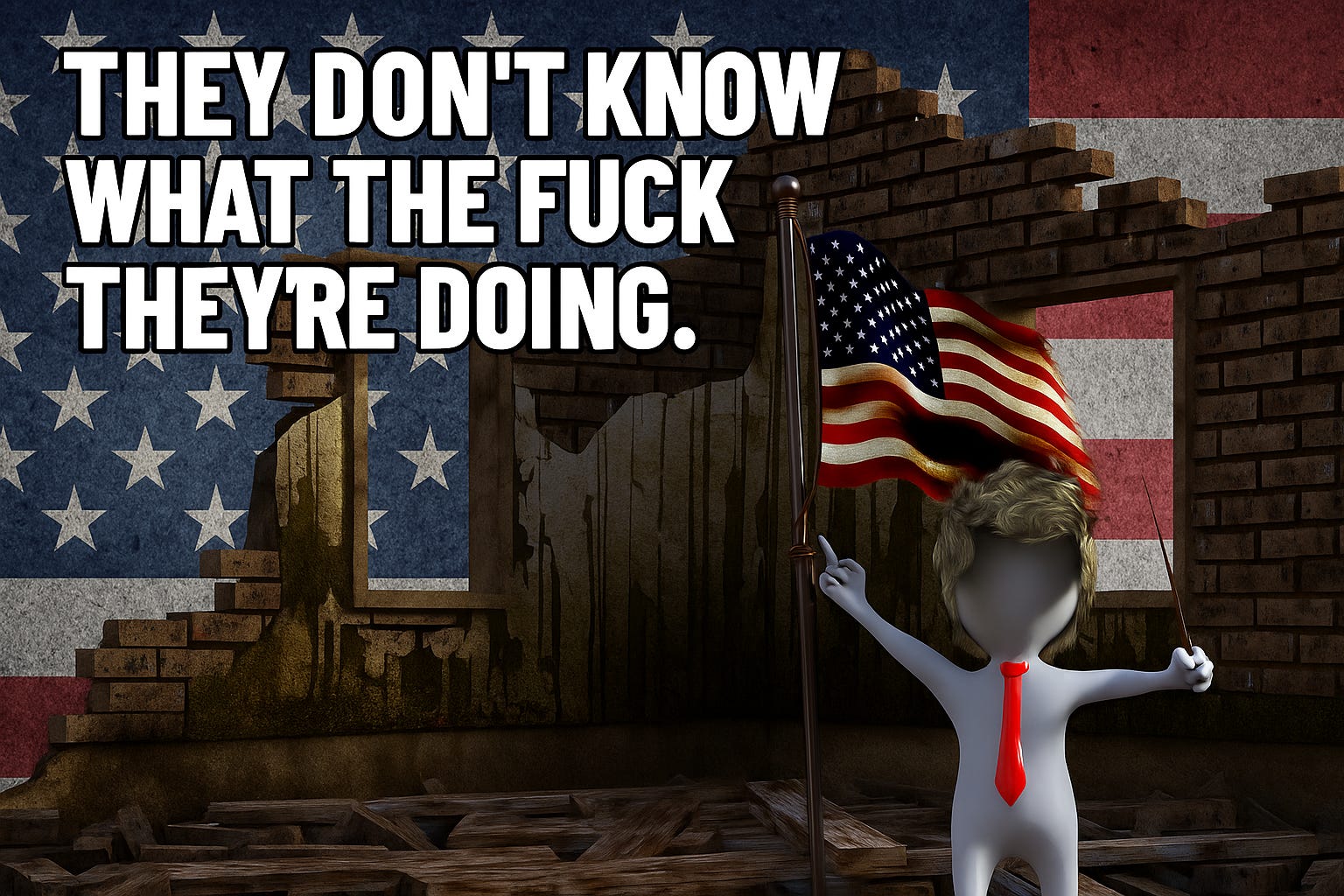
Two days after the U.S. launched airstrikes on Iranian nuclear sites, President Trump said something unfiltered and revealing:
“They don’t know what the fuck they’re doing.”
He meant Israel and Iran, but he might as well have meant everyone in power for the last 12,000 years.
For once, he told the truth. Not just a personal jab or deflection. A global diagnosis.
Because if world leaders did know what they were doing, we would not be standing at the edge of war, climate collapse, and systemic inequality.
A Fragile Ceasefire
Just hours before the outburst, Trump had taken credit for brokering peace. He declared a ceasefire between Israel and Iran, claiming the “12-Day War” was over. Media outlets ran with it. Praise rolled in. But behind the scenes, it was already unraveling.
Israel launched another mission that morning. Then the U.S. responded with more strikes. So much for peace.
This wasn’t a strategy. It was improvisation. And that’s what yesterday’s piece, War With Iran: How We Got Here, captured so well. A pattern of reckless moves, conflicting signals, and decisions made on the fly.
Global Leadership Is Guessing
Trump’s rant was classic projection. But for once, it hit the mark. Who actually knows what they’re doing on the world stage right now?
The U.S. pulled out of the Iran deal, then bombed Iran.
Israel acted unilaterally, knowing it could drag us in.
Iran postured, retaliated, then went silent.
The world watched, confused.
This isn’t unique to Iran. It’s everywhere. No one has a clear plan. Just slogans, blame, and reaction.
No One Is Steering
If our leaders truly had wisdom and foresight:
We’d have meaningful climate policy.
We’d see a reduction in poverty, not record inequality.
We’d be phasing out nuclear weapons, not deploying more.
We’d be investing in peace, not funding endless wars.
But we don’t. The systems are running on inertia. The decisions are being made for optics. War is entertainment. Diplomacy is theater. People suffer. Leaders pose.
Who Benefits From the Confusion?
When no one knows what they’re doing, opportunists thrive. They hijack moments of crisis to tighten their grip on power. Netanyahu exploited October 7 to crush dissent and escalate conflict. Trump used airstrikes to boost his image. Iran’s hardliners used the attacks to stir nationalism.
And regular people, Israelis, Iranians, and Americans are the ones who pay the price.
The Climate Clock Keeps Ticking
Meanwhile, the biggest threat to humanity is burning away in the background. Climate change is not waiting for us to figure this out. Every delay, every distraction, every new war sets us back years.
There’s no plan for the planet. Just profits, pipelines, and politics.
Stop Pretending Someone Else Has the Answers
We were raised to believe someone was in charge. That adults in suits had a plan. That the global system, with all its institutions and think tanks and treaties, had direction.
But Trump let the truth slip: they don’t know what they’re doing.
Not in Iran or the Middle East. Not on climate. Not on inequality. Not on peace.
When the Top Is Clueless, the Bottom Must Act
If leadership is broken, then real leadership must come from us.
Local communities can build the food, energy, and healthcare systems we actually need.
Organizers and activists can bring clarity and courage to the chaos.
Artists, educators, and thinkers can name the truth and imagine something better.
They may not have the bombs or the budget, but they have something else: intention.
A Chance to Start Over
This moment isn’t just dangerous. It’s revealing. When the veil slips and the incompetence shows, we’re free to stop pretending. We’re free to question the entire structure.
We can stop outsourcing responsibility to elites who keep fumbling.
We can stop waiting for permission to fix what’s broken.
We can stop believing the lie that someone else is coming to save us.
Trump Was Right And That Should Scare Us
“They don’t know what the fuck they’re doing.”
He meant it as an insult. It was also a confession. And a warning.
Because if the people who control the weapons, the policies, and the economies are making it up as they go, then it’s up to us to peacefully and democratically step in with vision, compassion, and clarity.
We can’t bomb our way to peace. We can’t greenwash our way to survival. And we can’t meme our way out of collapse.
But we can choose a different path. Together. Locally. Systemically. From the ground up.
Let’s stop being shocked that they’re lost. Let’s start building a participatory democracy that knows where it’s going.
Further Reading
War With Iran: How We Got Here – EssayX Substack
Stephen Wertheim, Tomorrow, the World
Chris Hedges, The Greatest Evil Is War
Arundhati Roy, Capitalism: A Ghost Story
The Guardian, Ceasefire timeline and briefing