
Concentration Camps Begin With Paperwork
How Stripping Haitians of Legal Status Prepares America for Mass Detention

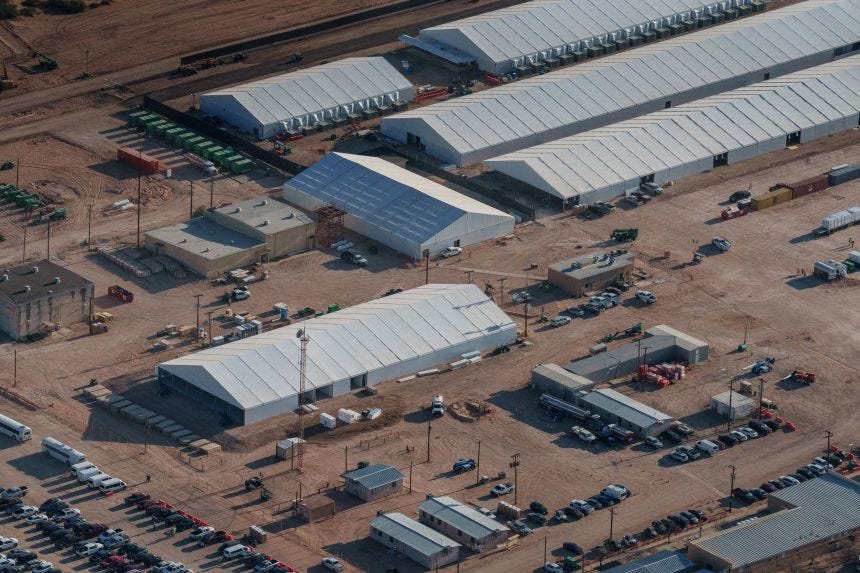
‘‘You cannot deport people at scale without camps, and you cannot justify camps without first stripping people of legal personhood.’’
Yesterday’s court ruling stopping the Trump administration from terminating Haiti’s Temporary Protected Status did more than pause a deportation order. It exposed the machinery behind it.
The effort to deport Haitians is not an isolated immigration dispute, nor is it a hardline policy disagreement over borders. It is a test case. It reveals how a government moves from law enforcement to population control, from administrative process to mass detention, and from rhetoric to infrastructure. It shows how concentration camps are not announced, but assembled quietly through paperwork, ideology, and logistics.
To understand what is happening, we have to stop thinking of deportation and detention as separate issues. They are two halves of the same system.
Status Is the First Wall to Fall
Temporary Protected Status exists for a reason. Congress created it to prevent chaos. When disaster makes return unsafe, people are granted a lawful, temporary right to live and work in the United States. TPS is not charity. It is statute. It is meant to be predictable, insulated from politics, and governed by evidence.
That insulation is exactly what the Trump administration tried to destroy.
By attempting to terminate Haiti’s TPS designation without following legal criteria, the administration sought to do something very specific: take hundreds of thousands of people who were legally present on Monday and render them deportable by Tuesday. No crimes committed. No hearings held. Just a switch flipped.
This is how mass detention begins. Not with arrests, but with reclassification.
People do not have to be dangerous to be detained. They only have to be redefined.
Deportation at Scale Requires Camps
Mass deportation is not an abstraction. It is a physical operation. People must be located, seized, held, processed, transported, and expelled. Every step requires space. Every space requires funding. Every facility requires normalization.
You cannot deport hundreds of thousands of people without building places to put them first.
This is why detention infrastructure expands whenever deportation rhetoric escalates. It is not reactive. It is preparatory. Camps are not built because of a sudden surge. They are built because a surge is planned.
When an administration targets an entire protected population like Haitian TPS holders, it signals intent. It is telling you that legality itself is provisional, and that detention capacity must grow to match that flexibility.
Manufactured Illegality Is the Engine
The most dangerous move in this process is not cruelty. It is paperwork.
TPS holders are not undocumented. They have work permits. They pay taxes. They are embedded in communities. Their labor participation rate is higher than the national average. They are nurses, engineers, lab assistants, students, and caregivers.
That is precisely why they must be made illegal first.
Authoritarian systems do not begin by rounding up people who clearly violate the law. They begin by changing the law, or ignoring it, so that compliance becomes irrelevant. Once legality can be revoked wholesale, detention becomes administrative rather than punitive, and moral resistance weakens.
If someone is “illegal,” then holding them is framed as enforcement, not imprisonment. Camps are reframed as processing centers. Indefinite detention becomes a bureaucratic inconvenience rather than a constitutional crisis.
This is how a nation convinces itself that cages are reasonable.
Camps Are Sold as Temporary, Then Normalized
Every detention camp begins as an exception. An emergency. A temporary solution.
That language is essential. It reassures the public that nothing fundamental is changing. But camps have a way of outliving emergencies. Once built, they develop constituencies. Budgets expand. Contractors profit. Entire bureaucracies form around keeping them full and functional.
Empty camps are treated as waste. Full camps are treated as a success.
Over time, what was once unthinkable becomes mundane. Indefinite detention without trial is accepted for some people, then more. The only real debate becomes who belongs inside.
This is why the Haitian case matters. It is not about border control. It is about whether the United States accepts the idea that lawful presence can be erased by ideology, and that mass detention is a legitimate tool of governance.
Race Determines Who Goes First
Haitians were not targeted because of crime. The court record makes that clear. There is no evidence supporting claims of danger, burden, or fraud. The facts run in the opposite direction.
They were targeted because of who they are.
The rhetoric used by administration officials is not incidental. Calling immigrants “killers,” “leeches,” and “invaders” is not policy language. It is dehumanization. It is preparation. It conditions the public to see a group as undeserving of rights, and therefore suitable for confinement.
Camps are never neutral spaces. Even when laws claim neutrality, enforcement reveals priorities. When entire programs protecting nonwhite immigrants are terminated en masse, while facts are ignored, race is doing the work.
This is how camps become racialized without ever saying the word race.
What Happens When the Camps Are Built
History answers this question with brutal consistency.
Once camps exist, they do not remain empty.
When undocumented immigrants are no longer sufficient to justify the infrastructure, the definition of “illegal” expands. TPS holders today. Asylum seekers tomorrow. Visa overstays next. Then, naturalized citizens are accused of paperwork fraud. Then, citizens labeled threats.
Criminality is redefined downward. Minor violations become detention triggers. Protest becomes disorder. Association becomes suspicion. Due process erodes quietly, replaced by administrative discretion.
Eventually, political enemies are folded into the system. Activists are labeled extremists. Journalists are accused of undermining national morale. Dissent is reframed as danger. Citizenship becomes conditional, something you keep by behaving correctly.
This is not speculation. It is pattern recognition.
No authoritarian state has ever built camps and then voluntarily dismantled them once the initial target population was gone. The structure demands bodies. The ideology supplies justification.
Why Courts Matter, and Why They Are Under Attack
The ruling stopping the termination of Haitian TPS matters because it interrupts the machinery. It insists that law still applies. Those facts still matter. That ideology does not override statute.
That is why the administration’s response has not been reflection, but escalation elsewhere. Increased ICE violence. Politicization of law enforcement. Attacks on election infrastructure. Calls to nationalize voting. Efforts to hollow out democratic accountability while expanding executive power.
When courts block one path, authoritarians search for another.
This Is Not About Immigration
It never was.
This is about whether the United States remains a constitutional society or becomes a carceral state with elections as performance. It is about whether legality is stable or contingent. It is about whether rights are inherent or revocable.
The effort to deport Haitians reveals the blueprint. Strip legal status. Build detention capacity. Normalize confinement. Expand targets. Suppress dissent. Blame the victims.
Camps are not built to solve problems. They are built to change what a society is willing to tolerate.
Stopping them begins long before the fences go up. It begins by refusing to accept the first lie, that some people’s legal personhood is optional.
Because once a country accepts cages for Haitians, it is not deciding who deserves them. It is deciding whether cages belong in its future at all.
I know some may not want to commit to a paid subscription, but if you’d like to support my work, you can always buy me a coffee on Ko-fi. Your contribution helps sustain independent writing rooted in consciousness, compassion, and social renewal. Every bit of support truly makes a difference.
Thank you for another excellent essay, Michael❣️I feel nauseous a lot these days 🤮 🤢. What is happening is so inconceivable and unforgivable!!! Inconceivable, because just how short can people’s memory be? Just how unwilling can people be to learn from History? !!! Unforgivable, because these atrocities are vile, repugnant and evil! Where is the humanity?!!! We should know better!!!
In case you don’t think these MAGA and ICE cumstains on humanity are executing Hitler’s playbook, read this:
Among the limited responsibilities of the SS in prewar Germany were the concentration camps, small stateless zones inside Germany itself. This *precedent of statelessness* was Hitler’s fifth innovation. Himmler established the first camp at Dachau in 1933 as a place where the National Socialist party (as opposed to the German state) could punish people- extralegally, as party leaders deemed necessary. The political enemy and the social enemy were the racial enemy, and the camps were to hold all of these groups. Placing socialists, communists, political dissidents, homosexuals, criminals, and people presented as ‘work-shy’ in the camps separated them from the normal protections of the state, and filtered them from the German national community. Their labor would help prepare Germany for a war that would destroy other states.
The most important aspect of the camps was the precedent they set. The concentration camp system within Germany in the 1930’s was not very expansive… German camps were chiefly important as a demonstration that organs of coercion could be separated by the Fuhrer’s will and barbed wire from the law and state. In this sense the concentration camps were training grounds for the more general SS mission beyond Germany: the destruction of states by racial institutions. (top of page 42)