
America's Reckoning Has Begun
A nation built on broken treaties and stolen land is unraveling. The consequences are here—and Indigenous wisdom may hold the only path forward.

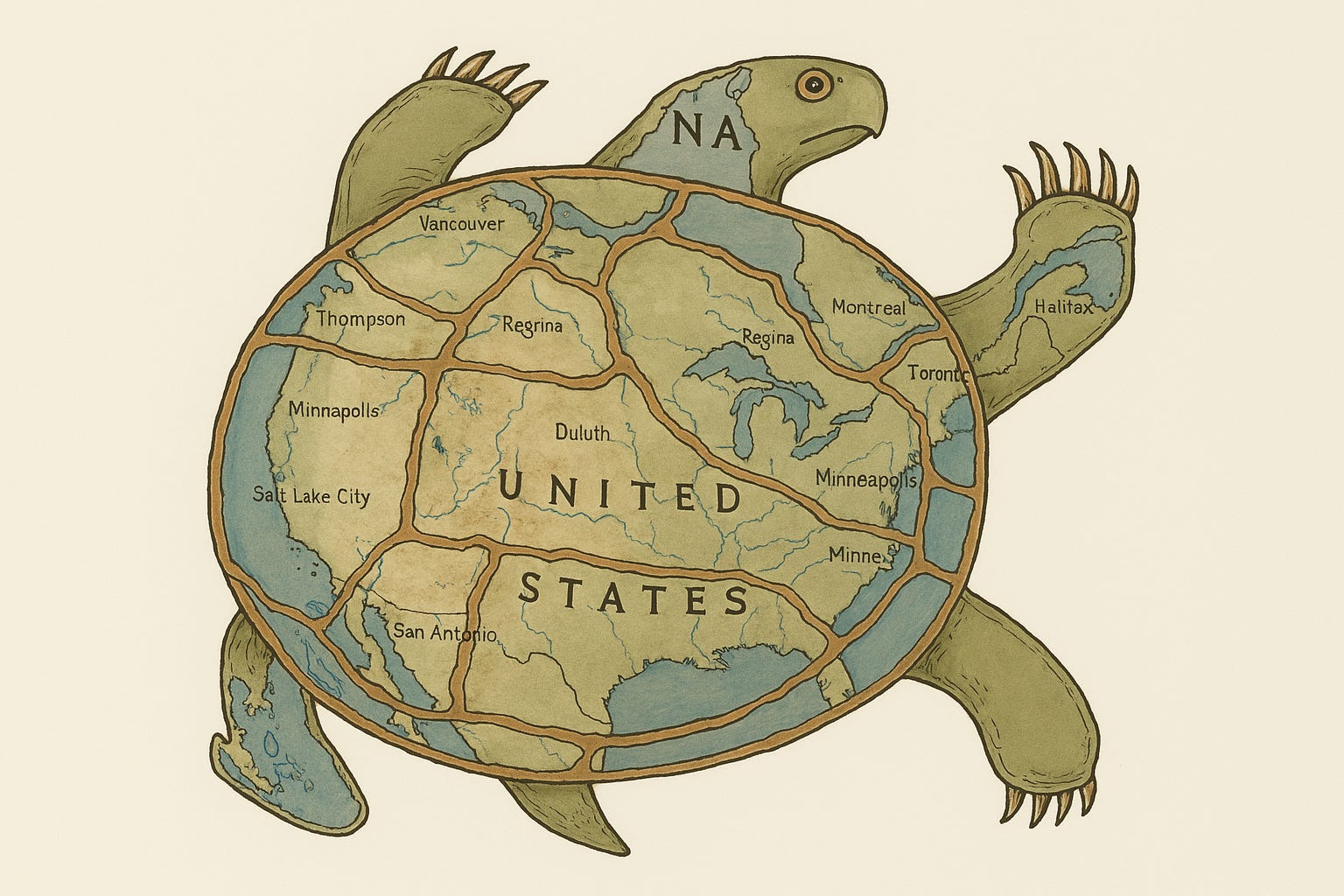
For many Indigenous peoples of North America, the land is not just geography; it is a living, breathing relative. Turtle Island is the name many nations use for this continent, rooted in creation stories that long predate colonization. The name itself carries a sacred cosmology of balance, reciprocity, and interdependence. In stark contrast, the United States was built on conquest, ownership, and domination.
‘‘Turtle Island is more than a name—it’s a living truth. The land was never empty, never ours to take. The reckoning is here: climate collapse, spiritual disconnection, rising resistance. Indigenous wisdom holds the key. Will we finally listen, or repeat the harm?’’
This essay explores the spiritual and historical consequences of that divergence. What happens when a culture built on sacred reciprocity is bulldozed by one built on extraction? The answer lies in the karma of Turtle Island—the unfolding consequences of centuries of ecological destruction, broken treaties, cultural genocide, and spiritual disconnection. And now, as we look around the United States today, we can see the reckoning is no longer looming on the horizon. It has already begun.
The Sacred Origins of Turtle Island
In the oral histories of the Anishinaabe, Haudenosaunee, and Lenape peoples, among others, Turtle Island emerged after a great flood covered the Earth. Sky Woman fell from the heavens and landed on the back of a great turtle. Animals like muskrat, beaver, and otter helped bring soil from beneath the waters, placing it on the turtle’s back to create land.
These stories are not meant to be read as literal myths, but as living truths, carrying deep ecological and spiritual wisdom. In this worldview, land is not a commodity—it is a being. Humans are not rulers of the Earth, but part of a vast and complex family that includes animals, rivers, forests, and the stars. The central value is balance, not accumulation. Communities made decisions with the seventh generation in mind. This framework, built on responsibility rather than entitlement, ensured the health of ecosystems for thousands of years.
Colonial Disruption and the Breaking of Natural Law
When European colonizers arrived, they brought a drastically different worldview. The land was seen as empty (terra nullius) and waiting to be claimed. The Doctrine of Discovery, a series of papal decrees beginning in the 15th century, declared that Christian nations had the divine right to seize non-Christian lands. This belief in divine entitlement was embedded in the founding of the United States, enshrined in policies like Manifest Destiny and the Indian Removal Act.
These ideologies shattered Indigenous systems of balance. Millions of Native people were killed, displaced, or forced into assimilation. Entire civilizations were upended. Sacred sites were bulldozed, rivers dammed, and buffalo exterminated. Treaties were made and broken with impunity. Children were taken from their families and placed in residential schools where they were beaten for speaking their languages. The karmic cost of this is not just historical—it is ongoing.
Environmental Karma and the Rupture of Relationship
One of the clearest expressions of this karmic unraveling is the environmental crisis. The same mindset that allowed colonists to steal land and destroy cultures also led to the commodification of nature. Forests became lumber, rivers became power sources, animals became meat, and the land itself was carved up for profit.
Today, the U.S. is facing the consequences: climate change, mass extinction, poisoned water, deforestation, and soil degradation. Fires rage across the West, hurricanes grow more intense, and entire regions face desertification. These are not random disasters—they are symptoms of a deeper spiritual illness. Indigenous elders have long warned that when we harm the Earth, we harm ourselves.
Traditional ecological knowledge—which sees humans as caretakers, not owners—offers a path forward. But it has been ignored or actively suppressed. Only recently has there been broader recognition that Indigenous stewardship is key to conservation. The karmic irony is that those who were pushed aside as “primitive” hold the wisdom most needed for our collective survival.
Social Reckoning and the Rise of Indigenous Movements
Just as the land is reacting, so too are the people. Indigenous communities are rising up to reclaim their rights, their cultures, and their land. The Standing Rock Sioux Tribe's resistance to the Dakota Access Pipeline was a turning point. The Land Back movement, which seeks the return of Indigenous territory, is gaining traction.
These movements are not about revenge—they are about restoration. They challenge a system that continues to benefit from colonization and call for accountability. They ask uncomfortable questions: Whose land are you on? What treaties were broken to put your house, school, or business there? What will justice look like?
This is karmic tension in real time. The past is not past; it lives in the laws, the land, the schools, and the prisons. True healing requires more than acknowledgment. It requires return.
The Reckoning All Around Us
Today’s United States is showing the cracks of that long-ignored history. The climate crisis, wealth inequality, mass shootings, and the erosion of democratic norms are not isolated issues. They’re part of a larger unraveling. The nation is spiritually unmoored, politically polarized, and ecologically collapsing. The karma of disconnection—from the land, from history, from each other—is manifesting in every part of life.
The rising mental health crisis, addiction epidemics, and alienation among youth are symptoms of a society built on separation, not belonging. And yet, Indigenous frameworks offer a map home: connection, reverence, responsibility.
This is not the end—it is the turning. But only if we choose it.
What Justice Could Look Like
Justice begins with truth. Every school in the United States should teach the real history of how this country was built. Every citizen should know the names of the original stewards of their land. But truth without action is hollow.
Reparative justice could include honoring treaty obligations, returning federal lands to Indigenous control, and supporting Native-led education, healthcare, and ecological restoration. It means recognizing Indigenous sovereignty not as symbolic, but as legal and actionable.
Environmental policies should be crafted with Indigenous consultation at the center. Water rights must be respected. Sacred sites must be protected. These are not acts of charity—they are moral debts owed.
The Path to Rebalancing
The reckoning has already begun. It’s not a single event—it’s a cascade. The Earth is demanding balance. Indigenous peoples are demanding justice. The question for the rest of us is: Will we continue down the road of disconnection, or will we finally return to relationship?
To heal the karma of Turtle Island, we must listen to the original voices of this land—not as relics of the past, but as leaders of a possible future. A future rooted in reciprocity, respect, and responsibility—the values that once made Turtle Island whole.
Further Reading:
The Rediscovery of North America by Barry Lopez – a powerful reflection on colonization, violence, and the spiritual repair required to live ethically on this continent.
Yet another tour de force from you, Michael. Agreed on all points you have so eloquently articulated regarding “Turtle Island.”
“Civilized’ man of the modern era has shown himself to be unworthy of his wrongly-gained position of power and dominance. The wheel of Karma must turn, leaving his morally bankrupt society destitute before real change for the better may emerge.
Because your knowledge, ideas and wisdom are closely in alignment with those of the Green Party, and like entities, I encourage you to connect with them all, for I feel certain they would embrace you as a most welcome and valued party elder.
enjoyed your writing